I teach corporate finance, valuation and investment philosophies at the Stern School of Business at New York University. I have online versions of all three courses here, as well as other finance-related videos. 1. The Corporate Finance Online playlist has an introductory video and 36 sessions that cover all of corporate finance (at least as I see it). 2. The Valuation playlist has 25 sessions that cover valuation approaches, issues and questions.3. The Investment Philosophies playlist has sessions that cover different investment philosophies.4. The Accounting and Statistics playlists reflect…
This is Session 23 from Aswath Damodaran's valuation course at NYU Stern, focusing on real options in corporate finance. The episode covers three interconnected topics: (1) the option to expand, where companies make upfront investments that appear unprofitable in isolation but are justified by the ability to enter or…
Worth it if you're a finance student, analyst, or investor seeking to understand how option theory applies to expansion decisions, financial flexibility, and valuing equity in troubled companies.
This is Session 17 of Aswath Damodaran's corporate finance course, focusing on the capital structure decision—specifically the trade-off between debt and equity financing. The episode begins by establishing foundational distinctions: debt as fixed claims with no control rights versus equity as residual claims with…
Worth it if you're a finance student, corporate strategist, or investor seeking to understand how companies should balance debt and equity financing across different contexts and life stages.
This is a 59-minute session from Aswath Damodaran's valuation course at NYU Stern, focusing on real options theory—specifically the option to delay. Damodaran applies this financial concept to practical valuation problems, particularly patents and undeveloped natural resource reserves. The episode appears to be a…
Worth it if you're a finance professional, investor, or student needing to value patents, natural resources, or any asset with embedded optionality.
This is Session 19 from Aswath Damodaran's valuation course at NYU Stern, focusing on the foundational concepts of pricing companies. The episode distinguishes between the pricing process and the intrinsic value process, establishing why pricing (using multiples) is far more prevalent in practice than fundamental…
Worth it if you're a serious investor or student building foundational knowledge in relative valuation and want to learn from one of the field's leading educators.
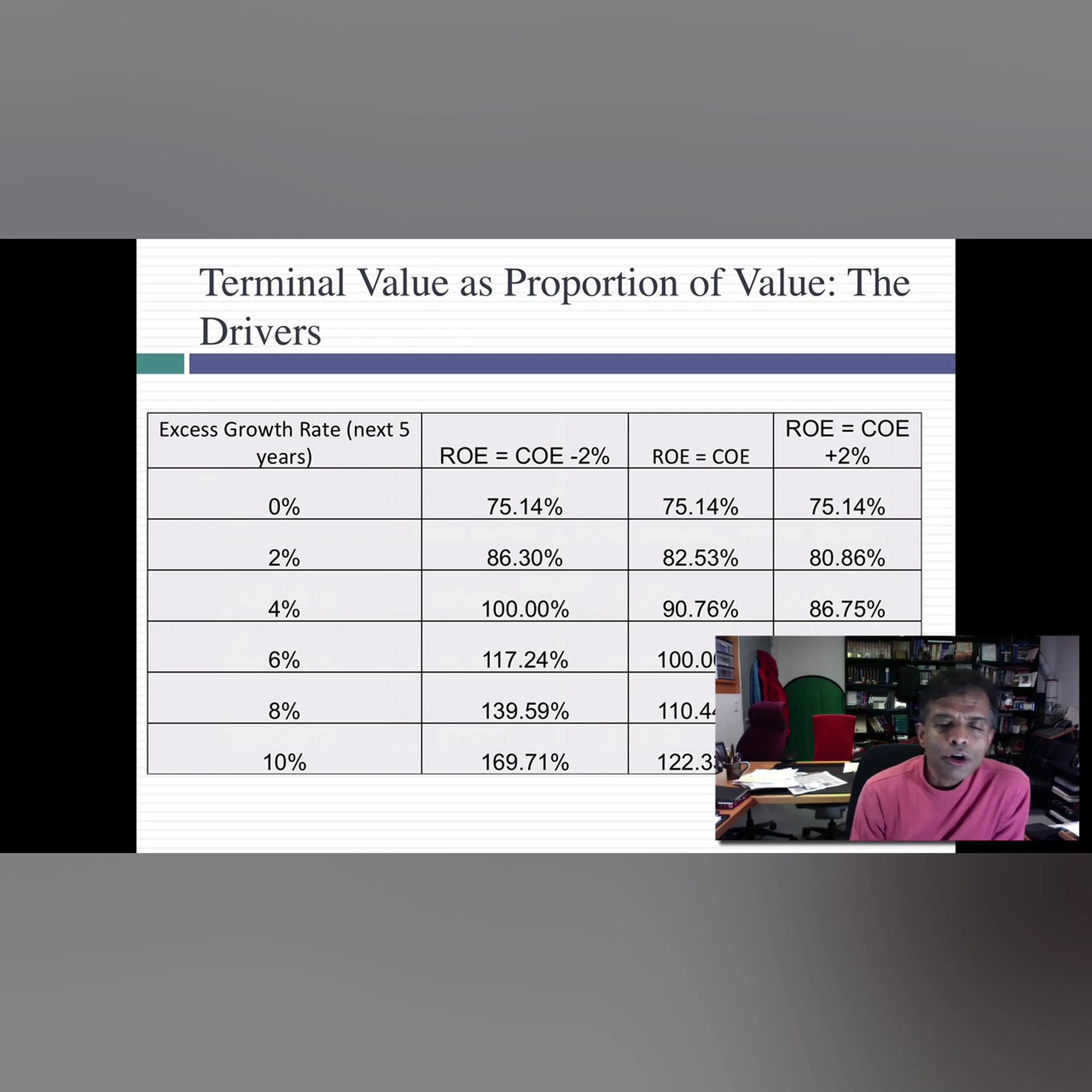
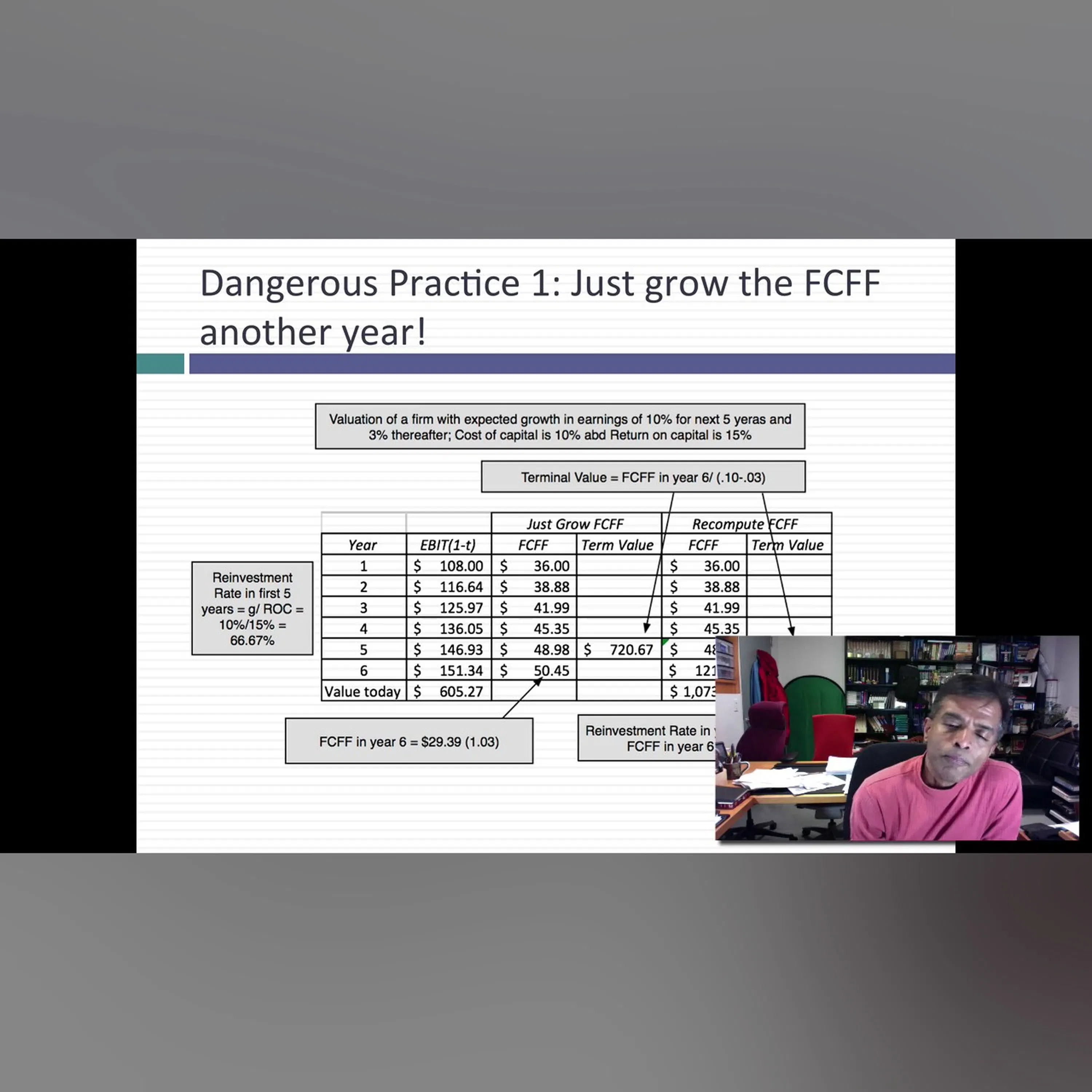
Aswath Damodaran, a renowned valuation expert from NYU Stern, addresses a common misconception about discounted cash flow (DCF) analysis in this 12-minute episode. The core myth he tackles is that terminal value—the estimated value of a business beyond the explicit forecast period—represents a problematic flaw in DCF…
Worth it if you use DCF models, are skeptical of their terminal value component, or want to understand why near-term forecasting assumptions matter even when terminal value dominates valuation.
Aswath Damodaran, a renowned valuation professor at NYU Stern, tackles a common misconception in financial modeling: the belief that discounted cash flow (DCF) analysis cannot accommodate negative growth rates. The episode challenges the myth that perpetual growth models break down when companies face declining…
Worth it if you're a financial analyst, investor, or student of valuation who wants to challenge assumptions about DCF modeling and improve your ability to value declining or mature businesses.
This is Session 18 from Aswath Damodaran's corporate finance course at NYU Stern, focusing on optimizing a company's financing mix—the balance between debt and equity. The episode builds on previous discussions of the debt trade-off by incorporating agency costs and financial flexibility into the analysis. Damodaran…
Worth it if you're studying corporate finance, need to understand debt-equity optimization for your role, or want to learn from one of the field's best teachers.
Aswath Damodaran, a renowned valuation expert from NYU Stern, tackles a fundamental misconception in corporate finance: the assumption that growth always increases firm value. The episode challenges the "perpetual growth model" myth by introducing consistency requirements that complicate this seemingly straightforward…
Worth it if you're an investor, analyst, or executive who needs to evaluate growth strategies critically and avoid the trap of pursuing growth that destroys shareholder value.
This is Session 18 from Aswath Damodaran's valuation course at NYU Stern, focusing on deconstructing valuation multiples—a core tool in equity research and stock pricing. Damodaran walks through the analytics behind common multiples: PEG (price-to-earnings-to-growth), PBV (price-to-book value), EV/EBITDA, and revenue…
Worth it if you're serious about equity research, value investing, or financial analysis and want to understand why cheap-looking stocks often deserve their low valuations.
Aswath Damodaran, a renowned valuation expert from NYU Stern, addresses a critical misconception in financial modeling: the behavior of terminal value calculations in perpetual growth models as the growth rate (g) approaches the discount rate (r). The episode uses a Toy Story reference (Buzz Lightyear's "to infinity…
Worth it if you build DCF models, teach valuation, or want to understand why terminal value calculations can blow up when growth rates approach discount rates.
This is Session 20 of Aswath Damodaran's valuation course, focusing on how to analyze and interpret valuation multiples—a core tool in equity research and stock pricing. Damodaran structures the session as a teaching exercise where he adopts the persona of a naive equity analyst using sloppy multiple-based reasoning…
Worth it if you're learning equity valuation, building stock screening models, or want to understand why most cheap-looking stocks deserve their low prices.
Aswath Damodaran, a renowned valuation professor at NYU Stern, challenges a widespread misconception in corporate finance: that discounted cash flow (DCF) analysis requires assuming perpetual growth at a constant rate to estimate terminal value. In this 9-minute episode, Damodaran presents the core thesis that this is…
Worth it if you work in valuation, teach finance, or have absorbed the textbook assumption that DCF requires perpetual growth assumptions.
This is Session 19 of Aswath Damodaran's corporate finance course on optimal capital structure, specifically focused on optimal financing mix. The episode addresses several interconnected topics: first, it resolves loose ends from prior cost-of-capital discussions, explaining why moving to an optimal debt ratio…
Worth it if you're a finance student, corporate strategist, or CFO seeking rigorous grounding in optimal debt ratio theory and how to apply it to real companies.
This is Session 21 from Aswath Damodaran's valuation course at NYU Stern, a 94-minute lecture covering two major topics: private company valuation (particularly IPOs) and an introduction to real options theory. In the first half, Damodaran addresses practical questions that arise when valuing private…
Worth it if you're learning valuation, managing private company investments, or preparing for IPO analysis and need rigorous grounding in real options theory.
This is Session 19 of Aswath Damodaran's valuation course, focusing on relative valuation methodology and how to price young companies using forward multiples. The session closes out the relative valuation unit by addressing a critical practical problem: how to select the "right" multiple for a valuation. Damodaran…
Worth it if you're studying valuation formally, want to understand the mechanics and pitfalls of relative valuation, or need data-backed frameworks for selecting appropriate valuation multiples.
Aswath Damodaran, a renowned valuation expert and NYU Stern professor, walks through his real-time decision-making process regarding a Valeant investment gone wrong. In May 2016, he purchased Valeant at $27 per share, valuing it at $44. By November 2016, the stock had crashed to $15—a 44% loss from his entry price and…
Worth it if you are an investor or student of valuation who wants to see how an expert reasons through a deteriorating position and wrestles with hope versus evidence.