
Session 20: Analyzing Multiples
Evaluation and Summary
This is Session 20 of Aswath Damodaran's valuation course, focusing on how to analyze and interpret valuation multiples—a core tool in equity research and stock pricing. Damodaran structures the session as a teaching exercise where he adopts the persona of a naive equity analyst using sloppy multiple-based reasoning to justify buy recommendations. He walks through common multiples including PEG (price-to-earnings-to-growth), PBV (price-to-book value), EV/EBITDA, and revenue multiples, demonstrating how analysts often misuse them by focusing only on whether a multiple is "low" without examining underlying fundamentals. The central thesis is that most companies appearing cheap on multiple-based screens actually deserve their low valuations—they lack the growth, profitability, or returns to justify higher prices. Damodaran emphasizes that effective valuation requires finding genuine mismatches: stocks with low PE ratios paired with high growth, low price-to-book with high return on equity, or low EV-to-sales with high margins. This principle underpins most equity research screening strategies. The episode includes interactive elements: Damodaran solicits pushback from the audience on his deliberately flawed recommendations, turning the session into a critical thinking exercise. He provides extensive supplementary materials—slides, pre-class and post-class tests with solutions, and a referenced blog post on passive value investing screening—suggesting this is part of a structured academic course at NYU Stern. The content is highly technical and assumes familiarity with financial metrics and valuation concepts. It's designed for students or practitioners learning to distinguish between genuine value opportunities and value traps. The teaching method—using bad analysis as a foil to illustrate good practice—is pedagogically sound but requires active engagement. The episode delivers squarely on its title promise: it analyzes multiples in depth, explaining their mechanics, common pitfalls, and proper application. However, the source material provides limited detail on specific sector examples, case studies, or quantitative data supporting the claims, making it difficult to assess the depth of evidence presented during the actual recording.
Verdict: A credible, substantive deep-dive into valuation multiples from a recognized expert with a clever pedagogical approach, but limited by sparse evidence in available materials and format better suited to classroom than podcast consumption.
Business rubric
-
Actionable takeaways 4/5 20%
Clear framework for identifying value: look for mismatches between low multiples and strong fundamentals (growth, ROE, margins), applicable to screening and stock analysis
-
Evidence over hype 3/5 20%
Teaching method uses realistic examples of flawed analysis, but show notes lack specific data, case studies, or quantitative evidence to verify claims about multiple effectiveness
-
Guest and host credibility 5/5 15%
Aswath Damodaran is a renowned valuation professor at NYU Stern with decades of teaching and practitioner experience; this is his core expertise
-
Substance 4/5 15%
Dense technical content on multiple analysis with interactive teaching method and supplementary materials (tests, slides, blog post), though show notes suggest some time spent on audience engagement rather than pure content delivery
-
Delivers on its title 5/5 15%
Title promises analysis of multiples; episode covers PEG, PBV, EV/EBITDA, revenue multiples and their proper application systematically
-
Value for time 3/5 15%
86 minutes for academic course content with interactive elements; appropriate for classroom setting but potentially padded for independent listening without visual aids
Worth it if you're learning equity valuation, building stock screening models, or want to understand why most cheap-looking stocks deserve their low prices.
Based on the episode description. AI-generated; it can be wrong.
Show notes
More from Aswath Damodaran

This is Session 23 from Aswath Damodaran's valuation course at NYU Stern, focusing on real options in corporate finance. The episode covers three interconnected topics: (1) the option to expand, where companies make upfront investments that appear unprofitable in isolation but are justified by the ability to enter or…
Worth it if you're a finance student, analyst, or investor seeking to understand how option theory applies to expansion decisions, financial flexibility, and valuing equity in troubled companies.

This is Session 17 of Aswath Damodaran's corporate finance course, focusing on the capital structure decision—specifically the trade-off between debt and equity financing. The episode begins by establishing foundational distinctions: debt as fixed claims with no control rights versus equity as residual claims with…
Worth it if you're a finance student, corporate strategist, or investor seeking to understand how companies should balance debt and equity financing across different contexts and life stages.

This is a 59-minute session from Aswath Damodaran's valuation course at NYU Stern, focusing on real options theory—specifically the option to delay. Damodaran applies this financial concept to practical valuation problems, particularly patents and undeveloped natural resource reserves. The episode appears to be a…
Worth it if you're a finance professional, investor, or student needing to value patents, natural resources, or any asset with embedded optionality.

This is Session 19 from Aswath Damodaran's valuation course at NYU Stern, focusing on the foundational concepts of pricing companies. The episode distinguishes between the pricing process and the intrinsic value process, establishing why pricing (using multiples) is far more prevalent in practice than fundamental…
Worth it if you're a serious investor or student building foundational knowledge in relative valuation and want to learn from one of the field's leading educators.
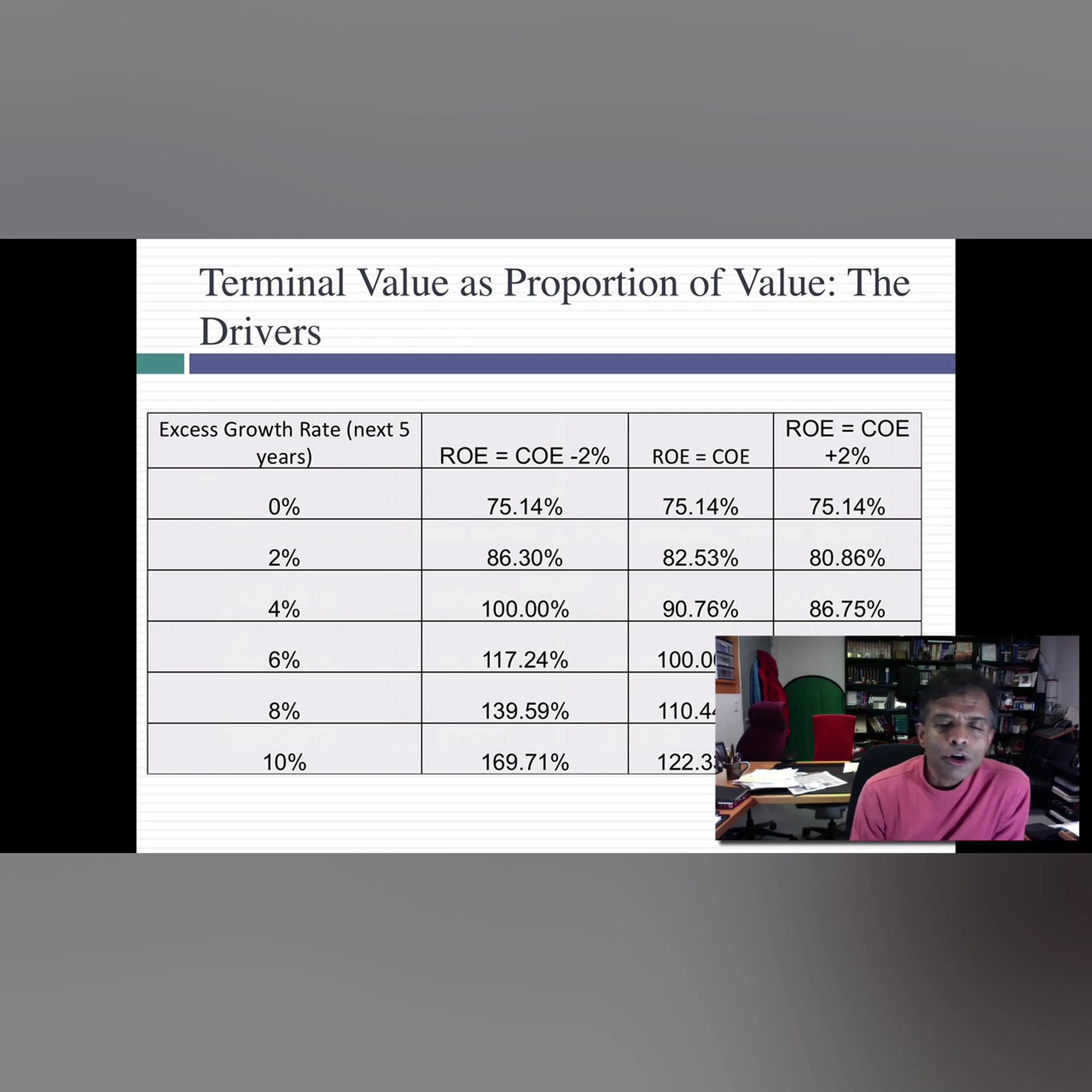
Aswath Damodaran, a renowned valuation expert from NYU Stern, addresses a common misconception about discounted cash flow (DCF) analysis in this 12-minute episode. The core myth he tackles is that terminal value—the estimated value of a business beyond the explicit forecast period—represents a problematic flaw in DCF…
Worth it if you use DCF models, are skeptical of their terminal value component, or want to understand why near-term forecasting assumptions matter even when terminal value dominates valuation.

Aswath Damodaran, a renowned valuation professor at NYU Stern, tackles a common misconception in financial modeling: the belief that discounted cash flow (DCF) analysis cannot accommodate negative growth rates. The episode challenges the myth that perpetual growth models break down when companies face declining…
Worth it if you're a financial analyst, investor, or student of valuation who wants to challenge assumptions about DCF modeling and improve your ability to value declining or mature businesses.