
Session 17: The Financing Mix Trade off
Evaluation and Summary
This is Session 17 of Aswath Damodaran's corporate finance course, focusing on the capital structure decision—specifically the trade-off between debt and equity financing. The episode begins by establishing foundational distinctions: debt as fixed claims with no control rights versus equity as residual claims with control. Damodaran then applies a life cycle framework to explain how much a company should borrow at different stages of growth. The bulk of the discussion examines the trade-offs systematically. On the debt side, he covers tax benefits (interest deductibility) and the disciplinary effect of mandatory debt service. On the equity side, he addresses the costs of debt: expected bankruptcy costs, agency costs (conflicts between debt and equity holders), and loss of financial flexibility. Rather than abstract theory, Damodaran uses comparative analysis to ground the discussion: why firms in some countries borrow more than others (regulatory, tax, and institutional differences), how earnings stability affects borrowing capacity (stable cash flows support more debt), and why asset composition matters (intangible assets reduce collateral value and borrowing capacity). The session includes slides, a post-class test, and solutions, suggesting this is part of a structured educational program rather than a standalone podcast. The material is technical but aimed at students or professionals learning corporate finance fundamentals.
Verdict: A substantive, well-structured exploration of capital structure fundamentals by a credible expert, with practical frameworks and comparative analysis, though lacking specific case studies or numerical examples that would elevate it further.
Business rubric
-
Actionable takeaways 3/5 20%
Provides frameworks (life cycle view, debt vs. equity trade-offs) and decision factors (earnings stability, asset type, country context) that practitioners can apply, but lacks specific numerical guidance or step-by-step implementation step
-
Evidence over hype 3/5 20%
Grounded in financial theory and comparative examples (cross-country borrowing patterns, asset-type effects) but show notes don't detail specific case studies, data points, or quantitative evidence presented.
-
Guest and host credibility 5/5 15%
Aswath Damodaran is a renowned NYU Stern professor and leading authority on valuation and corporate finance with decades of teaching and practitioner experience.
-
Substance 4/5 15%
Dense conceptual content covering multiple dimensions of capital structure (tax, bankruptcy, agency, flexibility) with comparative analysis; likely some repetition typical of classroom teaching but substantive throughout.
-
Delivers on its title 5/5 15%
Title promises discussion of financing mix trade-offs; episode systematically covers debt vs. equity advantages and disadvantages, life cycle considerations, and contextual factors affecting the choice.
-
Value for time 3/5 15%
93 minutes is substantial for classroom material; likely includes some pedagogical repetition and Q&A typical of lectures, though the breadth of topics covered justifies much of the length.
Worth it if you're a finance student, corporate strategist, or investor seeking to understand how companies should balance debt and equity financing across different contexts and life stages.
Based on the episode description. AI-generated; it can be wrong.
Show notes
More from Aswath Damodaran

This is Session 23 from Aswath Damodaran's valuation course at NYU Stern, focusing on real options in corporate finance. The episode covers three interconnected topics: (1) the option to expand, where companies make upfront investments that appear unprofitable in isolation but are justified by the ability to enter or…
Worth it if you're a finance student, analyst, or investor seeking to understand how option theory applies to expansion decisions, financial flexibility, and valuing equity in troubled companies.

This is a 59-minute session from Aswath Damodaran's valuation course at NYU Stern, focusing on real options theory—specifically the option to delay. Damodaran applies this financial concept to practical valuation problems, particularly patents and undeveloped natural resource reserves. The episode appears to be a…
Worth it if you're a finance professional, investor, or student needing to value patents, natural resources, or any asset with embedded optionality.

This is Session 19 from Aswath Damodaran's valuation course at NYU Stern, focusing on the foundational concepts of pricing companies. The episode distinguishes between the pricing process and the intrinsic value process, establishing why pricing (using multiples) is far more prevalent in practice than fundamental…
Worth it if you're a serious investor or student building foundational knowledge in relative valuation and want to learn from one of the field's leading educators.
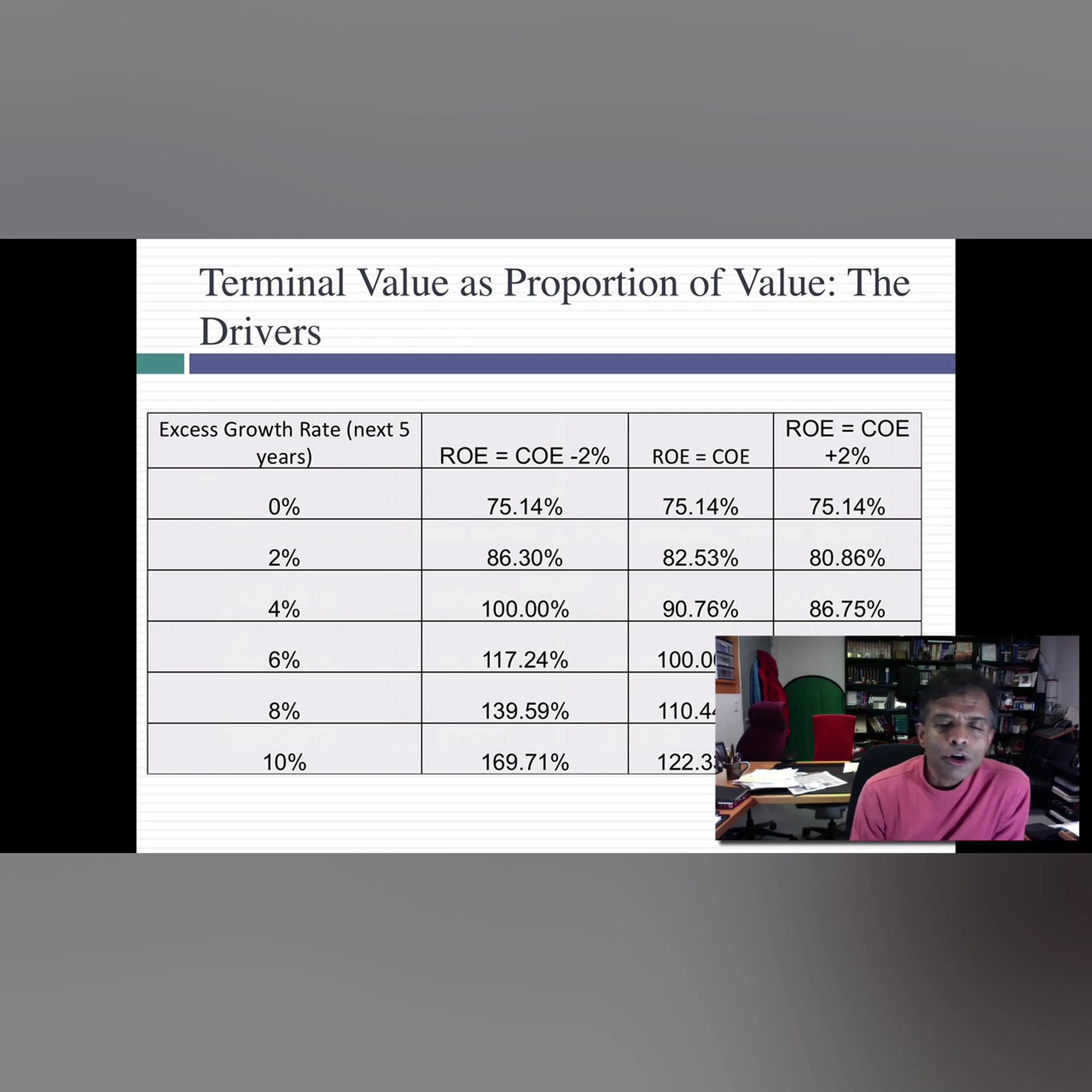
Aswath Damodaran, a renowned valuation expert from NYU Stern, addresses a common misconception about discounted cash flow (DCF) analysis in this 12-minute episode. The core myth he tackles is that terminal value—the estimated value of a business beyond the explicit forecast period—represents a problematic flaw in DCF…
Worth it if you use DCF models, are skeptical of their terminal value component, or want to understand why near-term forecasting assumptions matter even when terminal value dominates valuation.

Aswath Damodaran, a renowned valuation professor at NYU Stern, tackles a common misconception in financial modeling: the belief that discounted cash flow (DCF) analysis cannot accommodate negative growth rates. The episode challenges the myth that perpetual growth models break down when companies face declining…
Worth it if you're a financial analyst, investor, or student of valuation who wants to challenge assumptions about DCF modeling and improve your ability to value declining or mature businesses.

This is Session 18 from Aswath Damodaran's corporate finance course at NYU Stern, focusing on optimizing a company's financing mix—the balance between debt and equity. The episode builds on previous discussions of the debt trade-off by incorporating agency costs and financial flexibility into the analysis. Damodaran…
Worth it if you're studying corporate finance, need to understand debt-equity optimization for your role, or want to learn from one of the field's best teachers.