
Session 23: The Options to Expand and Abandon, Financial Flexibility and Distressed Equity
Evaluation and Summary
This is Session 23 from Aswath Damodaran's valuation course at NYU Stern, focusing on real options in corporate finance. The episode covers three interconnected topics: (1) the option to expand, where companies make upfront investments that appear unprofitable in isolation but are justified by the ability to enter or scale into large future markets; (2) the option to abandon, examining how the ability to exit poorly performing investments affects their valuation; and (3) financial flexibility as an option itself, arguing that the capacity to adapt to uncertainty is worth more to capital-constrained firms with high-value-added, unpredictable investments. The session then pivots to distressed equity—shares in debt-laden companies—and reframes equity in troubled firms as out-of-the-money options rather than conventional stocks. This lens yields three key implications: distressed equity retains value despite heavy debt loads, becomes more valuable as business risk increases, and benefits from longer debt maturity. The episode is structured as a classroom lecture with supporting materials including pre-class and post-class tests, slides, and solution sets, suggesting a rigorous academic treatment of how option theory applies to real business decisions and valuation.
Verdict: A rigorous, credible academic lecture on real options and distressed equity that delivers fully on its promise, with strong conceptual substance and expert instruction, though the show notes don't confirm whether examples and data are woven throughout or if pacing drags.
Business rubric
-
Actionable takeaways 3/5 20%
The framework for thinking about expansion, abandonment, and distressed equity is conceptually useful, but the show notes don't detail specific steps or examples a practitioner could immediately apply to their own valuation work.
-
Evidence over hype 3/5 20%
Damodaran is known for grounding theory in examples and data, but the show notes provide only the conceptual framework without revealing whether the lecture includes case studies, numbers, or empirical validation of the option-pricing appro
-
Guest and host credibility 5/5 15%
Aswath Damodaran is a world-renowned valuation expert and professor at NYU Stern with decades of experience teaching and applying option theory to real companies; his credibility is unquestionable.
-
Substance 4/5 15%
The episode covers substantial ground—three distinct but related real-option topics plus distressed equity analysis—with supporting test materials and slides indicating depth, though the show notes alone don't confirm how densely packed the
-
Delivers on its title 5/5 15%
The title explicitly promises coverage of options to expand and abandon, financial flexibility, and distressed equity; the show notes confirm all four topics are addressed in detail.
-
Value for time 3/5 15%
At 94 minutes, the episode covers multiple complex topics, but without hearing the pacing, it's unclear whether the length is tight or includes classroom tangents; the breadth suggests reasonable value but risks some padding.
Worth it if you're a finance student, analyst, or investor seeking to understand how option theory applies to expansion decisions, financial flexibility, and valuing equity in troubled companies.
Based on the episode description. AI-generated; it can be wrong.
Show notes
More from Aswath Damodaran

This is Session 17 of Aswath Damodaran's corporate finance course, focusing on the capital structure decision—specifically the trade-off between debt and equity financing. The episode begins by establishing foundational distinctions: debt as fixed claims with no control rights versus equity as residual claims with…
Worth it if you're a finance student, corporate strategist, or investor seeking to understand how companies should balance debt and equity financing across different contexts and life stages.

This is a 59-minute session from Aswath Damodaran's valuation course at NYU Stern, focusing on real options theory—specifically the option to delay. Damodaran applies this financial concept to practical valuation problems, particularly patents and undeveloped natural resource reserves. The episode appears to be a…
Worth it if you're a finance professional, investor, or student needing to value patents, natural resources, or any asset with embedded optionality.

This is Session 19 from Aswath Damodaran's valuation course at NYU Stern, focusing on the foundational concepts of pricing companies. The episode distinguishes between the pricing process and the intrinsic value process, establishing why pricing (using multiples) is far more prevalent in practice than fundamental…
Worth it if you're a serious investor or student building foundational knowledge in relative valuation and want to learn from one of the field's leading educators.
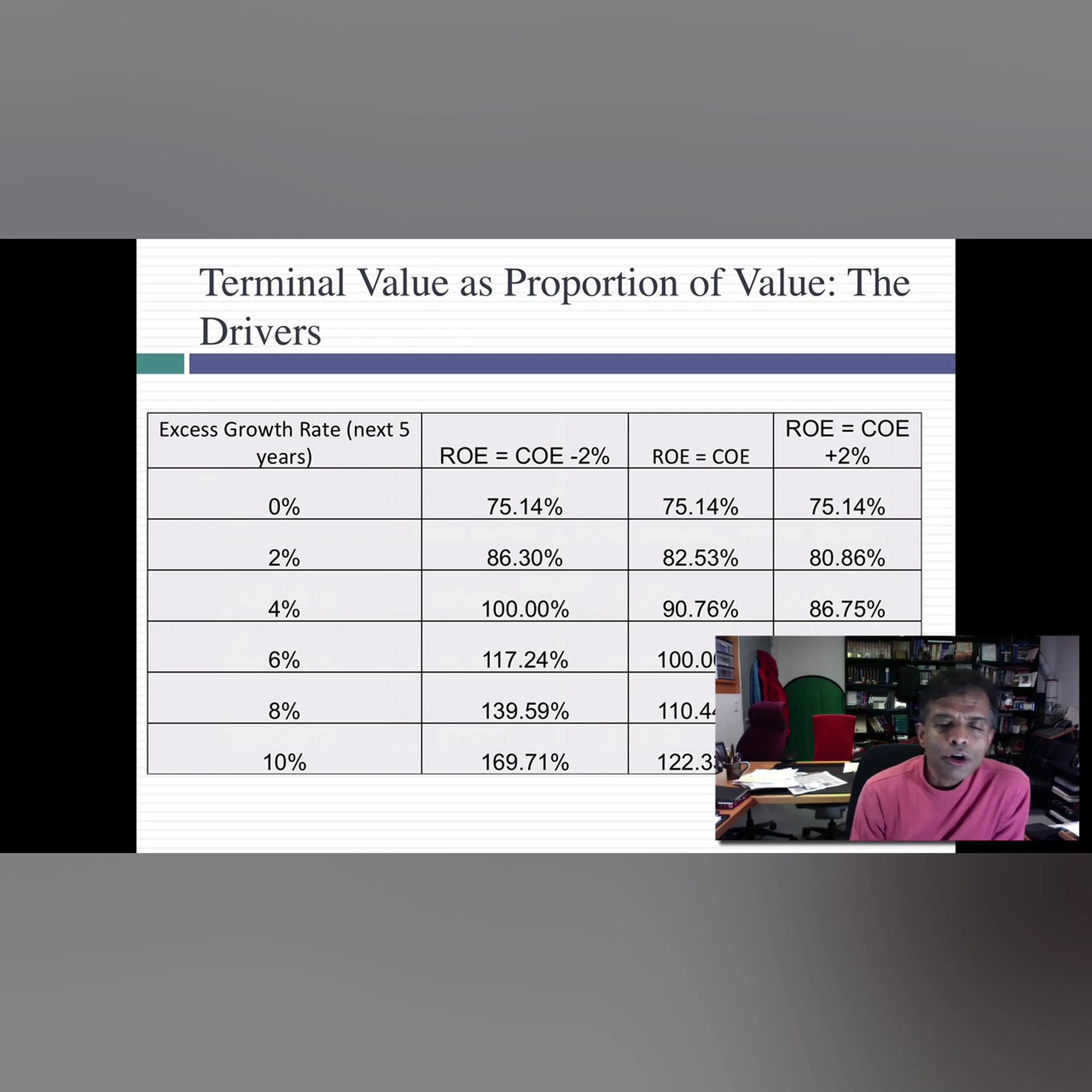
Aswath Damodaran, a renowned valuation expert from NYU Stern, addresses a common misconception about discounted cash flow (DCF) analysis in this 12-minute episode. The core myth he tackles is that terminal value—the estimated value of a business beyond the explicit forecast period—represents a problematic flaw in DCF…
Worth it if you use DCF models, are skeptical of their terminal value component, or want to understand why near-term forecasting assumptions matter even when terminal value dominates valuation.

Aswath Damodaran, a renowned valuation professor at NYU Stern, tackles a common misconception in financial modeling: the belief that discounted cash flow (DCF) analysis cannot accommodate negative growth rates. The episode challenges the myth that perpetual growth models break down when companies face declining…
Worth it if you're a financial analyst, investor, or student of valuation who wants to challenge assumptions about DCF modeling and improve your ability to value declining or mature businesses.

This is Session 18 from Aswath Damodaran's corporate finance course at NYU Stern, focusing on optimizing a company's financing mix—the balance between debt and equity. The episode builds on previous discussions of the debt trade-off by incorporating agency costs and financial flexibility into the analysis. Damodaran…
Worth it if you're studying corporate finance, need to understand debt-equity optimization for your role, or want to learn from one of the field's best teachers.