
Session 18: Deconstructing Multiples
Evaluation and Summary
This is Session 18 from Aswath Damodaran's valuation course at NYU Stern, focusing on deconstructing valuation multiples—a core tool in equity research and stock pricing. Damodaran walks through the analytics behind common multiples: PEG (price-to-earnings-to-growth), PBV (price-to-book value), EV/EBITDA, and revenue multiples. The pedagogical approach is particularly clever: Damodaran adopts the persona of a naive equity research analyst using sloppy, multiple-based pricing to justify buy recommendations across sectors. He deliberately makes weak arguments (low PE ratios, low PBV, low EV-to-sales) without considering underlying fundamentals, then invites pushback from the class. This Socratic method drives home the central lesson: most companies that appear cheap on multiples actually deserve to be cheap. The real insight is identifying mismatches between price and fundamentals—finding stocks with low PE but high growth, low PBB but high ROE, or low EV-to-sales but high margins. Damodaran frames this as the foundation of equity research screening strategies. The episode includes pre-class and post-class tests to reinforce learning, plus links to a detailed blog post on passive value investing and screening methodology. The 1 hour 38 minute runtime suggests a full university lecture with interactive elements, though the show notes don't detail specific company examples or numerical case studies discussed during the session itself.
Verdict: A rigorous, credible deep-dive into valuation multiples from a world-class instructor with practical frameworks and interactive teaching, though the academic format and lack of specific case-study details in the notes make it less immediately accessible than a commercial business podcast.
Business rubric
-
Actionable takeaways 4/5 20%
Provides a clear framework for identifying mispricings (low multiple + high fundamental metric) and references screening methodology; includes tests and supplementary materials for practice.
-
Evidence over hype 4/5 20%
Grounded in analytical metrics (PEG, PBV, EV/EBITDA, revenue multiples) and uses real-world sector examples; the Socratic method of testing weak arguments with pushback adds rigor, though specific data points aren't detailed in notes.
-
Guest and host credibility 5/5 15%
Aswath Damodaran is a legendary valuation professor at NYU Stern with decades of teaching and practitioner experience; this is his core expertise.
-
Substance 4/5 15%
Dense academic content covering multiple valuation frameworks with interactive teaching method; includes pre/post tests and supplementary resources, though show notes don't reveal depth of examples or case studies.
-
Delivers on its title 5/5 15%
Title promises deconstruction of multiples; episode systematically breaks down PEG, PBV, EV/EBITDA, and revenue multiples with clear analytical framework.
-
Value for time 3/5 15%
University lecture format with tests and supplementary materials suggests earned runtime, but 1h 38m is substantial; pacing unclear from notes alone, and some listeners may find academic depth slower than a tighter business podcast.
Worth it if you're serious about equity research, value investing, or financial analysis and want to understand why cheap-looking stocks often deserve their low valuations.
Based on the episode description. AI-generated; it can be wrong.
Show notes
More from Aswath Damodaran

This is Session 23 from Aswath Damodaran's valuation course at NYU Stern, focusing on real options in corporate finance. The episode covers three interconnected topics: (1) the option to expand, where companies make upfront investments that appear unprofitable in isolation but are justified by the ability to enter or…
Worth it if you're a finance student, analyst, or investor seeking to understand how option theory applies to expansion decisions, financial flexibility, and valuing equity in troubled companies.

This is Session 17 of Aswath Damodaran's corporate finance course, focusing on the capital structure decision—specifically the trade-off between debt and equity financing. The episode begins by establishing foundational distinctions: debt as fixed claims with no control rights versus equity as residual claims with…
Worth it if you're a finance student, corporate strategist, or investor seeking to understand how companies should balance debt and equity financing across different contexts and life stages.

This is a 59-minute session from Aswath Damodaran's valuation course at NYU Stern, focusing on real options theory—specifically the option to delay. Damodaran applies this financial concept to practical valuation problems, particularly patents and undeveloped natural resource reserves. The episode appears to be a…
Worth it if you're a finance professional, investor, or student needing to value patents, natural resources, or any asset with embedded optionality.

This is Session 19 from Aswath Damodaran's valuation course at NYU Stern, focusing on the foundational concepts of pricing companies. The episode distinguishes between the pricing process and the intrinsic value process, establishing why pricing (using multiples) is far more prevalent in practice than fundamental…
Worth it if you're a serious investor or student building foundational knowledge in relative valuation and want to learn from one of the field's leading educators.
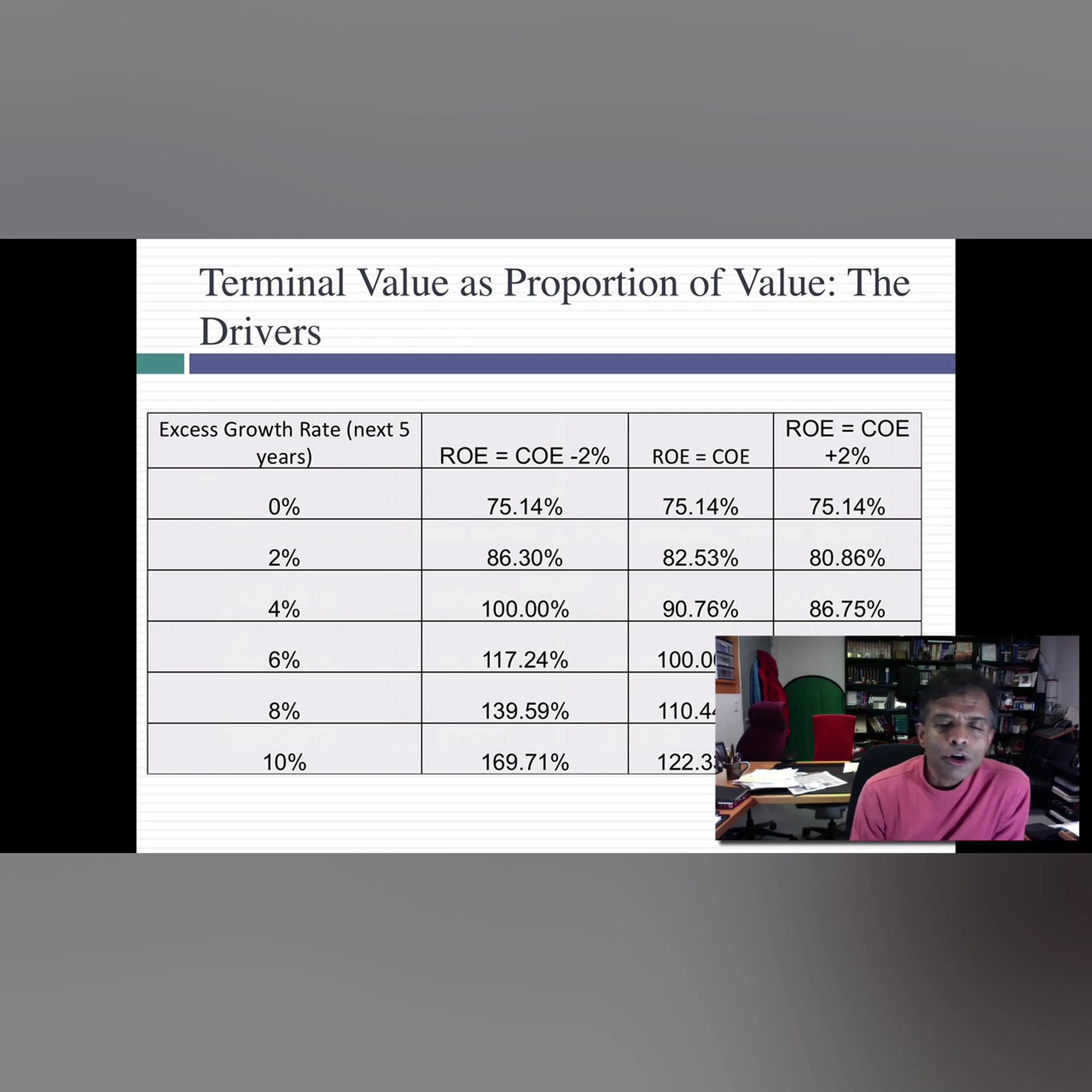
Aswath Damodaran, a renowned valuation expert from NYU Stern, addresses a common misconception about discounted cash flow (DCF) analysis in this 12-minute episode. The core myth he tackles is that terminal value—the estimated value of a business beyond the explicit forecast period—represents a problematic flaw in DCF…
Worth it if you use DCF models, are skeptical of their terminal value component, or want to understand why near-term forecasting assumptions matter even when terminal value dominates valuation.

Aswath Damodaran, a renowned valuation professor at NYU Stern, tackles a common misconception in financial modeling: the belief that discounted cash flow (DCF) analysis cannot accommodate negative growth rates. The episode challenges the myth that perpetual growth models break down when companies face declining…
Worth it if you're a financial analyst, investor, or student of valuation who wants to challenge assumptions about DCF modeling and improve your ability to value declining or mature businesses.