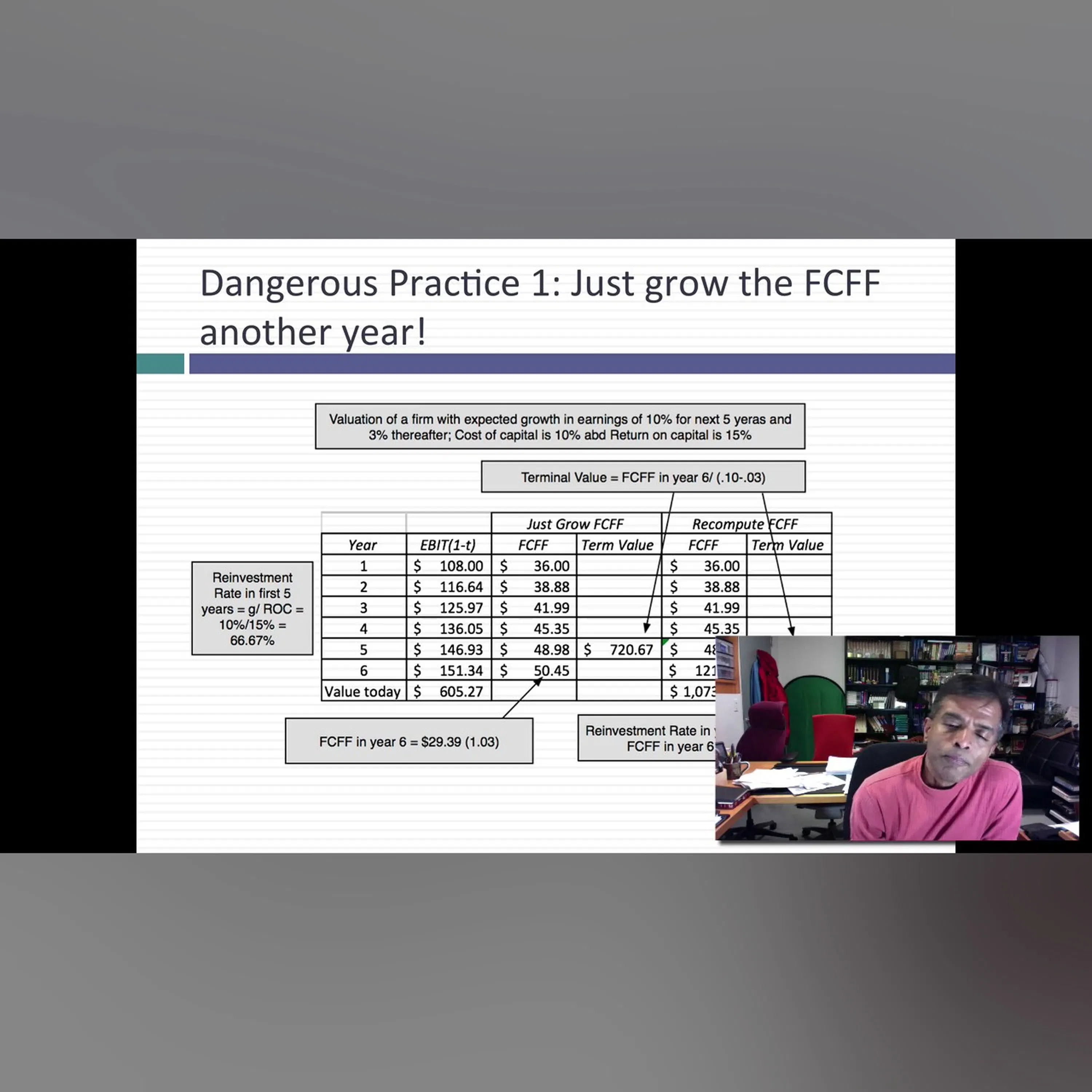
Terminal Value Myth 3: Growth is good, more growth is better!
Evaluation and Summary
Aswath Damodaran, a renowned valuation expert from NYU Stern, tackles a fundamental misconception in corporate finance: the assumption that growth always increases firm value. The episode challenges the "perpetual growth model" myth by introducing consistency requirements that complicate this seemingly straightforward relationship. Damodaran's core argument is that while the perpetual growth model suggests increasing growth rates will mechanically boost valuation (holding all else constant), this framework ignores real-world constraints. When you apply consistency requirements—the idea that growth must be sustainable and aligned with a company's fundamentals like reinvestment rates, return on invested capital, and cost of capital—the relationship between growth and value becomes far more nuanced. The key insight is that increasing growth doesn't automatically increase value; it can increase, decrease, or have no effect depending on how that growth is achieved and what trade-offs it requires. For example, pursuing aggressive growth might require higher reinvestment, which reduces free cash flows available to shareholders. Or it might increase financial risk, raising the cost of capital and offsetting valuation gains. Conversely, growth achieved through operational efficiency could genuinely boost value. The episode appears to be part of Damodaran's "Terminal Value Myths" series, which systematically debunks common misconceptions in valuation. He provides slides and a detailed blog post to support the discussion, suggesting a data-driven, educational approach rather than superficial commentary. At 15 minutes, this is a focused, technical deep-dive rather than a broad overview. The episode targets investors, financial analysts, and business leaders who need to think critically about growth strategy and valuation. Damodaran's reputation as a rigorous valuation theorist and practitioner lends credibility to the argument. The main takeaway is actionable for decision-makers: before pursuing growth, stress-test whether that growth actually creates value when you account for reinvestment needs, risk changes, and competitive dynamics. This challenges the common corporate reflex to chase growth at any cost.
Verdict: A sharp, credible debunking of a widespread corporate myth with actionable implications for investors and strategists, though the short format and reliance on supplementary materials limit accessibility.
Business rubric
-
Actionable takeaways 4/5 20%
Listeners gain a specific framework to challenge growth assumptions and stress-test whether growth actually creates value, though the episode notes don't detail concrete implementation steps.
-
Evidence over hype 4/5 20%
Damodaran is known for rigorous quantitative analysis; the episode references slides and a blog post with mathematical models, though the notes don't show specific case studies or numbers.
-
Guest and host credibility 5/5 15%
Aswath Damodaran is a legendary valuation professor and practitioner with decades of direct experience; he's a proven authority on corporate finance and valuation theory.
-
Substance 4/5 15%
The episode tackles a counterintuitive, substantive idea with supporting materials (slides, blog post), though the 15-minute format limits depth of examples and exploration.
-
Delivers on its title 5/5 15%
The title promises to debunk the myth that more growth is always better; the episode directly addresses this by explaining how growth's impact on value is ambiguous under consistency constraints.
-
Value for time 4/5 15%
15 minutes is tight for a technical valuation topic; the episode likely delivers core insight efficiently, though supplementary materials (slides, blog) are needed for full understanding.
Worth it if you're an investor, analyst, or executive who needs to evaluate growth strategies critically and avoid the trap of pursuing growth that destroys shareholder value.
Based on the episode description. AI-generated; it can be wrong.
Show notes
More from Aswath Damodaran

This is Session 23 from Aswath Damodaran's valuation course at NYU Stern, focusing on real options in corporate finance. The episode covers three interconnected topics: (1) the option to expand, where companies make upfront investments that appear unprofitable in isolation but are justified by the ability to enter or…
Worth it if you're a finance student, analyst, or investor seeking to understand how option theory applies to expansion decisions, financial flexibility, and valuing equity in troubled companies.

This is Session 17 of Aswath Damodaran's corporate finance course, focusing on the capital structure decision—specifically the trade-off between debt and equity financing. The episode begins by establishing foundational distinctions: debt as fixed claims with no control rights versus equity as residual claims with…
Worth it if you're a finance student, corporate strategist, or investor seeking to understand how companies should balance debt and equity financing across different contexts and life stages.

This is a 59-minute session from Aswath Damodaran's valuation course at NYU Stern, focusing on real options theory—specifically the option to delay. Damodaran applies this financial concept to practical valuation problems, particularly patents and undeveloped natural resource reserves. The episode appears to be a…
Worth it if you're a finance professional, investor, or student needing to value patents, natural resources, or any asset with embedded optionality.

This is Session 19 from Aswath Damodaran's valuation course at NYU Stern, focusing on the foundational concepts of pricing companies. The episode distinguishes between the pricing process and the intrinsic value process, establishing why pricing (using multiples) is far more prevalent in practice than fundamental…
Worth it if you're a serious investor or student building foundational knowledge in relative valuation and want to learn from one of the field's leading educators.
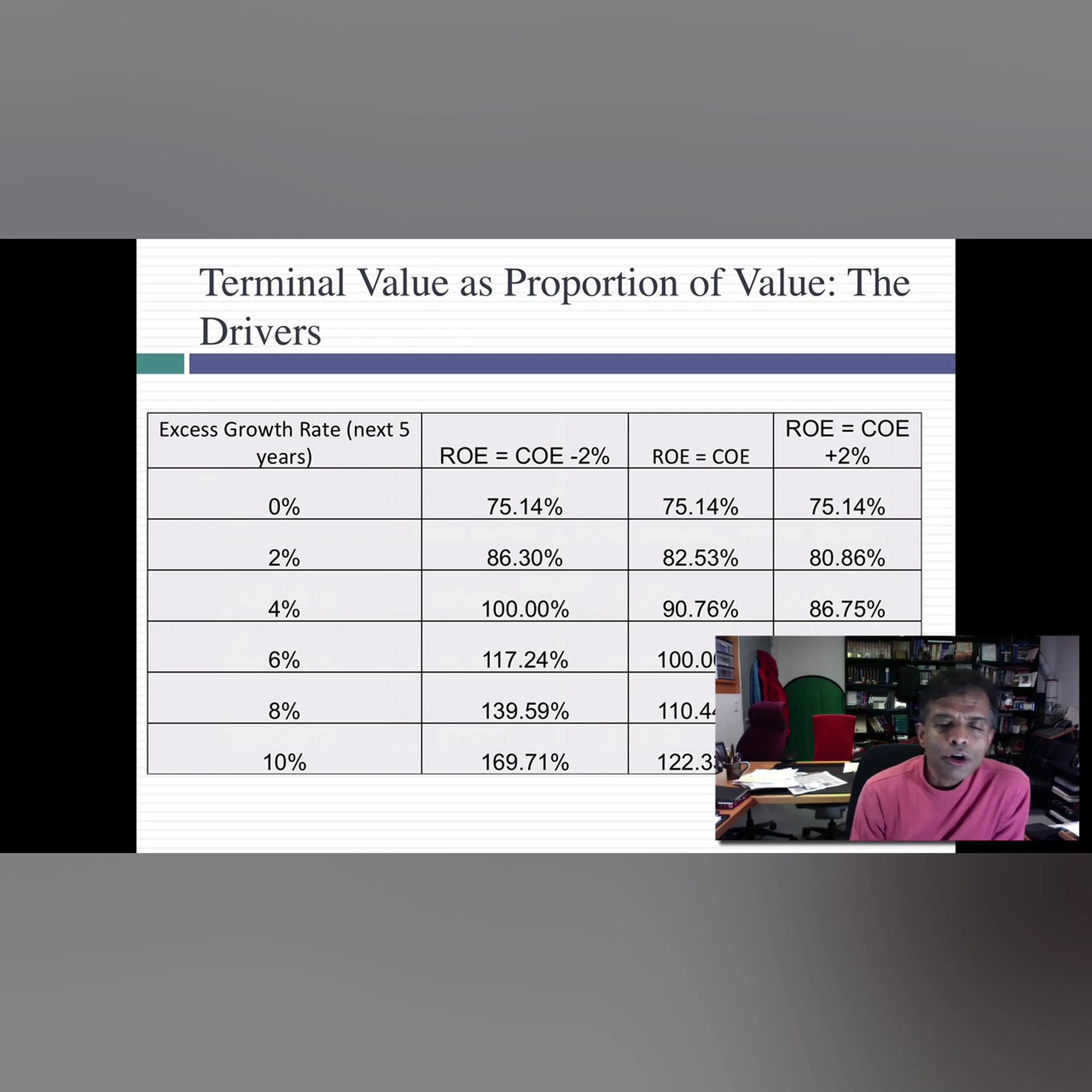
Aswath Damodaran, a renowned valuation expert from NYU Stern, addresses a common misconception about discounted cash flow (DCF) analysis in this 12-minute episode. The core myth he tackles is that terminal value—the estimated value of a business beyond the explicit forecast period—represents a problematic flaw in DCF…
Worth it if you use DCF models, are skeptical of their terminal value component, or want to understand why near-term forecasting assumptions matter even when terminal value dominates valuation.

Aswath Damodaran, a renowned valuation professor at NYU Stern, tackles a common misconception in financial modeling: the belief that discounted cash flow (DCF) analysis cannot accommodate negative growth rates. The episode challenges the myth that perpetual growth models break down when companies face declining…
Worth it if you're a financial analyst, investor, or student of valuation who wants to challenge assumptions about DCF modeling and improve your ability to value declining or mature businesses.