
Faith, Fear and Feedback: Ready for the Valeant Test?
Evaluation and Summary
Aswath Damodaran, a renowned valuation expert and NYU Stern professor, walks through his real-time decision-making process regarding a Valeant investment gone wrong. In May 2016, he purchased Valeant at $27 per share, valuing it at $44. By November 2016, the stock had crashed to $15—a 44% loss from his entry price and a 66% decline from his valuation target. Rather than offering a neat conclusion, Damodaran uses this case study to explore the psychological and analytical tensions investors face: faith in their thesis versus fear of further losses, and how to interpret negative feedback from the market. The episode title 'Faith, Fear and Feedback' directly frames these three competing forces. Damodaran explicitly invites listeners to judge whether he is letting hope override common sense in his reasoning about whether to abandon, hold, or add to the position. The webcast is accompanied by detailed slides and a blog post, suggesting a rigorous analytical approach. The format appears to be Damodaran reasoning through the decision aloud, likely drawing on his valuation framework and experience as an investor-educator. The episode is relatively short at 20 minutes, which limits depth but keeps focus tight. Valeant itself became a cautionary tale in investing—the company faced accounting scandals, drug pricing controversies, and management issues that justified the market's harsh repricing. Damodaran's willingness to examine his own potential cognitive biases (hope overriding sense) adds intellectual honesty to what could have been a defensive post-mortem. The episode does not appear to feature a guest; it is Damodaran's solo analysis. The takeaway is less 'here's what to do' and more 'here's how to think about a deteriorating position,' which is more introspective than prescriptive.
Verdict: A credible, intellectually honest case study from a top valuation expert that models real-time decision-making under uncertainty; limited by its brevity and introspective rather than prescriptive tone, but valuable for investors learning to manage cognitive bias.
Business rubric
-
Actionable takeaways 3/5 20%
Listeners gain a framework for re-evaluating a thesis under pressure (faith vs. fear vs. feedback), but the episode doesn't prescribe specific steps; it models reasoning rather than offering rules.
-
Evidence over hype 4/5 20%
Damodaran grounds the discussion in his actual valuation ($44 target), real prices ($27 entry, $15 current), and references detailed slides and a blog post; lacks external data on Valeant's fundamentals but shows his work.
-
Guest and host credibility 5/5 15%
Aswath Damodaran is a world-recognized valuation expert, NYU Stern professor, and prolific author; he is speaking from direct investment experience and proven analytical rigor.
-
Substance 3/5 15%
A 20-minute solo analysis of one investment decision is lean; the episode likely covers the core tension (faith vs. fear vs. feedback) but has limited room for deep exploration, examples, or alternative scenarios.
-
Delivers on its title 5/5 15%
The title 'Faith, Fear and Feedback' directly names the three forces Damodaran explicitly examines in deciding whether to hold, abandon, or add to Valeant; the episode fully addresses what it promises.
-
Value for time 4/5 15%
20 minutes is tight and focused on a single, concrete case; the pacing likely works well for the scope, though some listeners may want more depth or resolution.
Worth it if you are an investor or student of valuation who wants to see how an expert reasons through a deteriorating position and wrestles with hope versus evidence.
Based on the episode description. AI-generated; it can be wrong.
Show notes
More from Aswath Damodaran

This is Session 23 from Aswath Damodaran's valuation course at NYU Stern, focusing on real options in corporate finance. The episode covers three interconnected topics: (1) the option to expand, where companies make upfront investments that appear unprofitable in isolation but are justified by the ability to enter or…
Worth it if you're a finance student, analyst, or investor seeking to understand how option theory applies to expansion decisions, financial flexibility, and valuing equity in troubled companies.

This is Session 17 of Aswath Damodaran's corporate finance course, focusing on the capital structure decision—specifically the trade-off between debt and equity financing. The episode begins by establishing foundational distinctions: debt as fixed claims with no control rights versus equity as residual claims with…
Worth it if you're a finance student, corporate strategist, or investor seeking to understand how companies should balance debt and equity financing across different contexts and life stages.

This is a 59-minute session from Aswath Damodaran's valuation course at NYU Stern, focusing on real options theory—specifically the option to delay. Damodaran applies this financial concept to practical valuation problems, particularly patents and undeveloped natural resource reserves. The episode appears to be a…
Worth it if you're a finance professional, investor, or student needing to value patents, natural resources, or any asset with embedded optionality.

This is Session 19 from Aswath Damodaran's valuation course at NYU Stern, focusing on the foundational concepts of pricing companies. The episode distinguishes between the pricing process and the intrinsic value process, establishing why pricing (using multiples) is far more prevalent in practice than fundamental…
Worth it if you're a serious investor or student building foundational knowledge in relative valuation and want to learn from one of the field's leading educators.
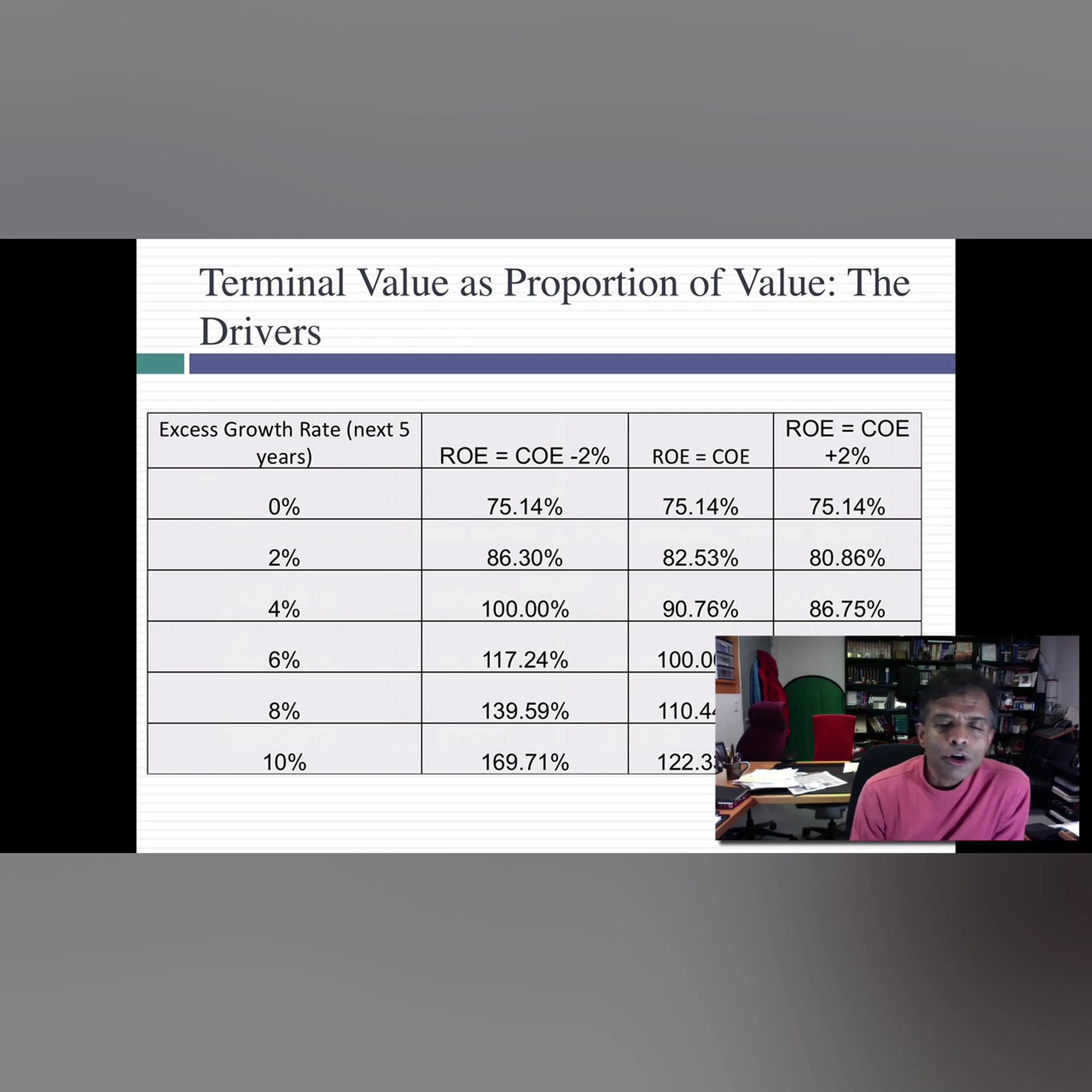
Aswath Damodaran, a renowned valuation expert from NYU Stern, addresses a common misconception about discounted cash flow (DCF) analysis in this 12-minute episode. The core myth he tackles is that terminal value—the estimated value of a business beyond the explicit forecast period—represents a problematic flaw in DCF…
Worth it if you use DCF models, are skeptical of their terminal value component, or want to understand why near-term forecasting assumptions matter even when terminal value dominates valuation.

Aswath Damodaran, a renowned valuation professor at NYU Stern, tackles a common misconception in financial modeling: the belief that discounted cash flow (DCF) analysis cannot accommodate negative growth rates. The episode challenges the myth that perpetual growth models break down when companies face declining…
Worth it if you're a financial analyst, investor, or student of valuation who wants to challenge assumptions about DCF modeling and improve your ability to value declining or mature businesses.