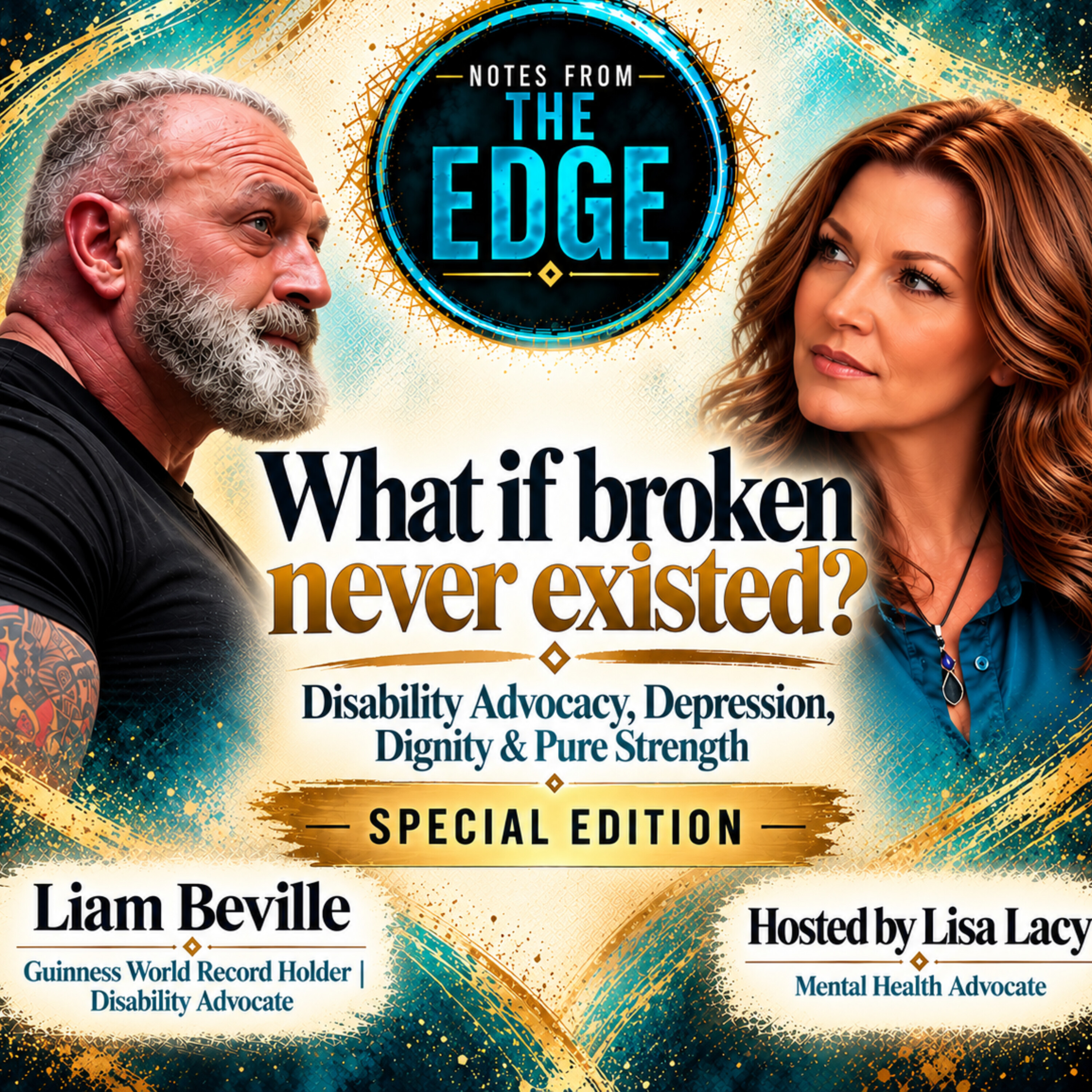
SPECIAL EDITION; The Unbroken Conversation with Liam Beville
Evaluation and Summary
Notes from the Edge presents a special edition featuring Lisa Lacy in conversation with Liam Beville, an 18-year-old who became a catastrophically injured survivor after pushing a friend from the path of a stolen car, shattering both legs and severely damaging his right knee. Rather than accepting a prognosis that he might never walk again, Beville rebuilt himself—first mentally, then physically—eventually becoming a Guinness World Record-holding elite powerlifter, disability advocate, speaker, and author. The episode explores the psychological and emotional dimensions of his recovery, including depression, PTSD, and loss of dignity. A central theme emerges: for decades, Beville performed strength and normalcy, even practicing his walk to hide his limp from others. The conversation examines how survival and resilience can become masks—how the drive to overcome can obscure the need to heal and accept. Beville's journey shifts when he stops viewing disability as something that diminishes his strength and instead integrates it into his identity. The episode frames this as a larger meditation on performance versus authenticity: that true strength sometimes means stopping the performance long enough to acknowledge trauma, that adaptation isn't surrender, and that asking for help isn't weakness. The listener's note reframes resilience itself—not as the absence of pain or limitation, but as the capacity to eventually stop performing survival and begin genuine healing. The episode promises to explore what happens when we stop hiding the parts of ourselves we worked hardest to conceal, positioning Beville's story as both personal testimony and universal reflection on identity, trauma, and the cost of appearing unbroken.
Verdict: A thoughtfully constructed conversation that promises to deconstruct the mythology of resilience through a compelling personal story, offering fresh perspective on trauma, identity and the cost of performance.
Society & Culture rubric
-
Fresh perspective 4/5 20%
Reframes resilience and strength as potentially performative rather than purely aspirational, offering a counternarrative to typical 'triumph over adversity' stories.
-
Storytelling and voices 4/5 20%
Features a specific, detailed personal narrative with emotional depth (depression, PTSD, hidden limp) and appears to include dialogue between host and guest, though the actual conversation content isn't provided.
-
Thoughtfulness 4/5 15%
Shows nuance in exploring the shadow side of resilience—how strength can become a mask, how survival strategies can outlive their usefulness, and the complexity of identity after trauma.
-
Substance 3/5 15%
Show notes promise substantive topics (mental recovery, PTSD, 40 years of competitive powerlifting, identity shifts) but the actual episode content is not provided, making depth assessment difficult.
-
Delivers on its title 4/5 15%
Title 'The Unbroken Conversation' appears to reference both Beville's memoir and the episode's exploration of what lies beneath the 'unbroken' facade, which the description directly addresses.
-
Value for time 3/5 15%
43 minutes is reasonable for a deep interview, though without hearing the actual pacing and flow, moderate assessment is appropriate; show notes suggest substantive material to justify the length.
How we score Society & Culture
Worth it if you're interested in disability narratives that go beyond inspiration, the psychology of trauma recovery, or honest explorations of how we construct identity after life-altering events.
Based on the episode description. AI-generated; it can be wrong.
Show notes
More from Notes from the Edge

Lisa Lacy interviews Kristen Renee Appleby, author and founder of The Rebuild Collective, about the intersection of burnout, autoimmune illness, and high-achiever culture. The core premise is that the drive to push through, perform, and achieve—traits that often lead to success—can become unsustainable when the body…
Worth it if you're a high-achiever experiencing burnout or autoimmune symptoms and want to explore the mind-body-environment connection from someone who's lived it.

Lisa Lacy interviews Jenna Schutt, a former cardiac nurse and stem cell transplant survivor, about living with chronic illness while maintaining an outward appearance of capability. Jenna was diagnosed with a rare, incurable disease at 30 while raising two young children, enduring ten rounds of chemotherapy, serious…
Worth it if you live with chronic illness, care for someone who does, struggle with performing strength, or want to understand the psychological toll of medical trauma and identity loss.

Notes from the Edge presents a special Mental Health Awareness Week episode featuring host Lisa Lacy discussing her lived experience with Bipolar I Disorder, Borderline Personality Disorder, and Complex PTSD—what she calls 'the Psychotic Trifecta.' Rather than offering clinical instruction, Lacy centers personal…
Worth it if you're seeking authentic first-person accounts of mental illness, want to understand psychosis beyond clinical definitions, or are navigating similar diagnoses and need validation that high functionality doesn't equal wellness.

Notes from the Edge hosts Lisa Lacy in conversation with Amy Lenius, a personal development coach and Director of Group Coaching at Next Level University. The episode reframes success as something built from within rather than chased externally, centering on three pillars: self-worth, self-belief, and consistency. Amy…
Worth it if you're interested in reframing success around internal alignment rather than external achievement, or if you resonate with chronic illness narratives and identity reconstruction.

Lisa Lacy interviews Dr. Eric Anderson, a neurologist and CMO at Lin Health, about chronic back pain and alternatives to surgery. The core premise challenges a common assumption: that pain intensity correlates with structural damage visible on MRI scans. Dr. Anderson explains central sensitization—how the nervous…
Worth it if you have chronic back pain, are considering back surgery, or want to understand how the nervous system amplifies pain signals beyond structural damage.

Lisa Lacy's 10-minute Edge Note examines the shadow side of positivity culture—specifically how the relentless push to 'look for the good,' practice gratitude, forgive, and trust that everything happens for a reason can become a form of spiritual bypassing that actually prevents healing and growth. The episode…
Worth it if you've felt pressured by positivity culture to suppress legitimate pain, or if you're curious about spiritual bypassing and how acceptance differs from resignation.