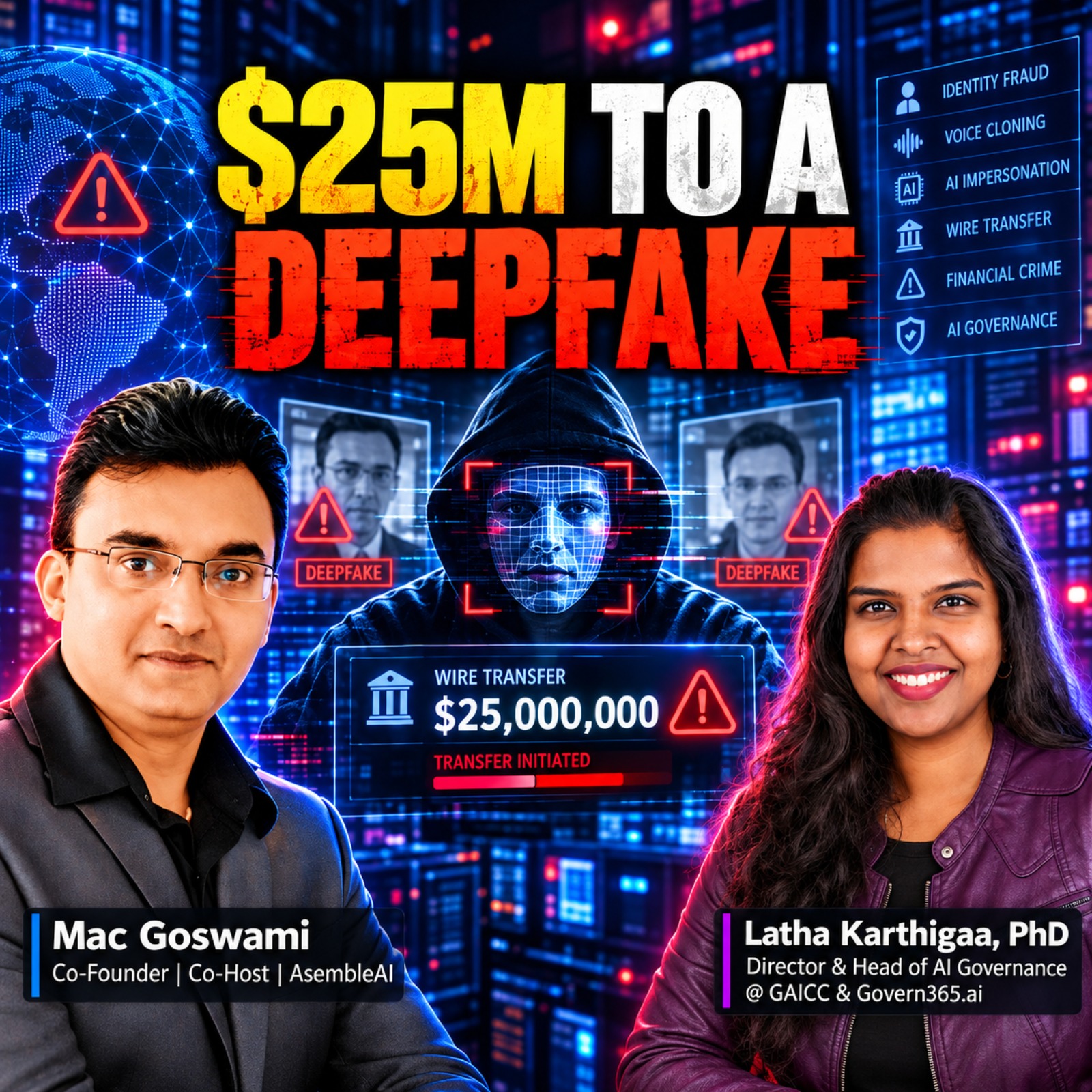
EP 77: They Transferred $25M to a Deepfake — Why Your AI Isn't as Governed as You Think | Dr. Latha Karthigaa
Evaluation and Summary
Inside AsembleAI EP 77 features Dr. Latha Karthigaa, Director & Head of AI Governance at the Global AI Certification Council, discussing why corporate AI governance is often inadequate despite companies believing they're compliant. The episode opens with a critical distinction: having a policy is not the same as having governance—Karthigaa uses a highway guardrail analogy to reframe governance as something that enables faster innovation rather than merely restricting it. The conversation centers on concrete failure cases. The headline example is a $25 million wire fraud at engineering firm Arup, where an employee transferred funds after a video call with his CFO and colleagues—all deepfakes generated from publicly available videos. This illustrates why employee training and human verification matter more than policies alone. Karthigaa cites alarming statistics: 2,000+ logged AI incidents, 400+ in 2025, with over 52% deepfake-driven, including a SpaceX/Elon Musk crypto scam that aired during a live rocket launch. The episode also examines systemic failures: IBM Watson's oncology tool was shut down due to biased training data, and the Dutch childcare-benefits algorithm falsely accused thousands of families, ultimately bringing down a government. A key theme is accountability: Karthigaa emphasizes that ChatGPT itself bears no responsibility—the deploying organization does. Every AI use case needs a named human owner. The episode addresses ISO/IEC 42001, the only certifiable AI standard, discussing when startups should pursue it and what it signals to customers. Karthigaa notes that AI governance roles are growing 150% year-over-year, reflecting rising demand. The core message: "Policy is like potential power. Execution is the real power." The episode positions governance not as compliance theater but as a competitive advantage and risk mitigation strategy, with emphasis on human judgment, empathy, and accountability structures rather than purely technical or policy-based solutions.
Verdict: A substantive, well-focused episode with a credible expert, concrete examples, and non-obvious insights about AI governance that go beyond compliance theater—valuable for anyone deploying AI systems.
Technology rubric
-
Technical accuracy 4/5 20%
Cites real incidents (Arup $25M deepfake, IBM Watson, Dutch childcare algorithm) and concrete statistics (52% deepfake incidents, 150% YoY growth in governance roles); no obvious errors detected in show notes, though depth of technical deta
-
Insight beyond the headlines 4/5 20%
Reframes governance as enabler rather than constraint (guardrail analogy); distinguishes policy from execution; emphasizes human accountability and training over compliance theater—these are non-obvious insights beyond typical AI risk cover
-
Clarity for non-experts 4/5 15%
Uses accessible analogies (highway guardrails); explains ISO/IEC 42001 in context; avoids heavy jargon while discussing technical failures; makes governance concepts concrete through real-world examples.
-
Substance 4/5 15%
Covers multiple dimensions: policy vs. execution, deepfake incidents, systemic failures, accountability structures, standards, and labor trends; substantive guest with relevant expertise; limited padding evident in show notes.
-
Delivers on its title 5/5 15%
Title promises explanation of why AI governance is inadequate and what responsible governance looks like; show notes confirm both are directly addressed through case studies, statistics, and Karthigaa's framework.
-
Value for time 4/5 15%
33 minutes for a focused governance discussion with named expert, multiple case studies, and actionable takeaways suggests efficient pacing; no evidence of filler or tangents in show notes.
Worth it if you work in AI deployment, risk management, or leadership roles where you need to understand why governance failures happen and how to build accountability structures that actually work.
Based on the episode description. AI-generated; it can be wrong.
Show notes
More from Inside AsembleAI: DeepTech, AI & Science
Inside AsembleAI's 32-minute episode features Rowan Stewart, AI and Data Safety Product Leader at Transcend, discussing the critical gap between AI agent deployment and governance. Stewart brings real-world experience from BCG and current work with enterprise clients including Robinhood, Brex, and Groupon. The core…
Worth it if you're building or deploying AI agents in an enterprise, managing AI risk, or trying to understand why governance matters before it becomes a crisis.
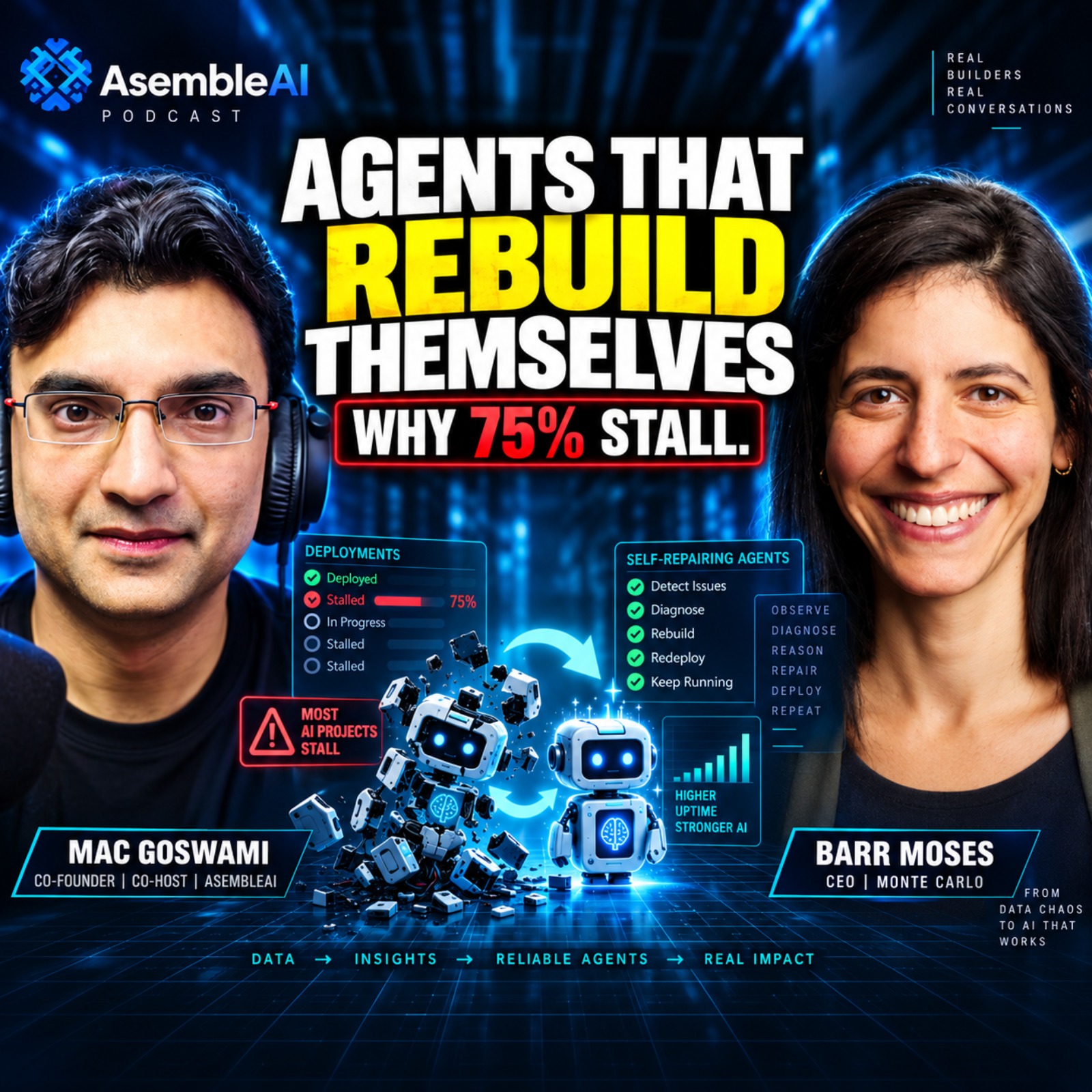
Recorded live at the AI4 conference, this 27-minute episode features Barr Moses, CEO of Monte Carlo Data, discussing the critical gap between AI trustworthiness in theory and production reality. Moses frames the core problem with a memorable distinction: traditional dashboards were "wrong in the background" (silently…
Worth it if you're building or deploying AI agents in production and want practical frameworks for catching failures before they reach users.
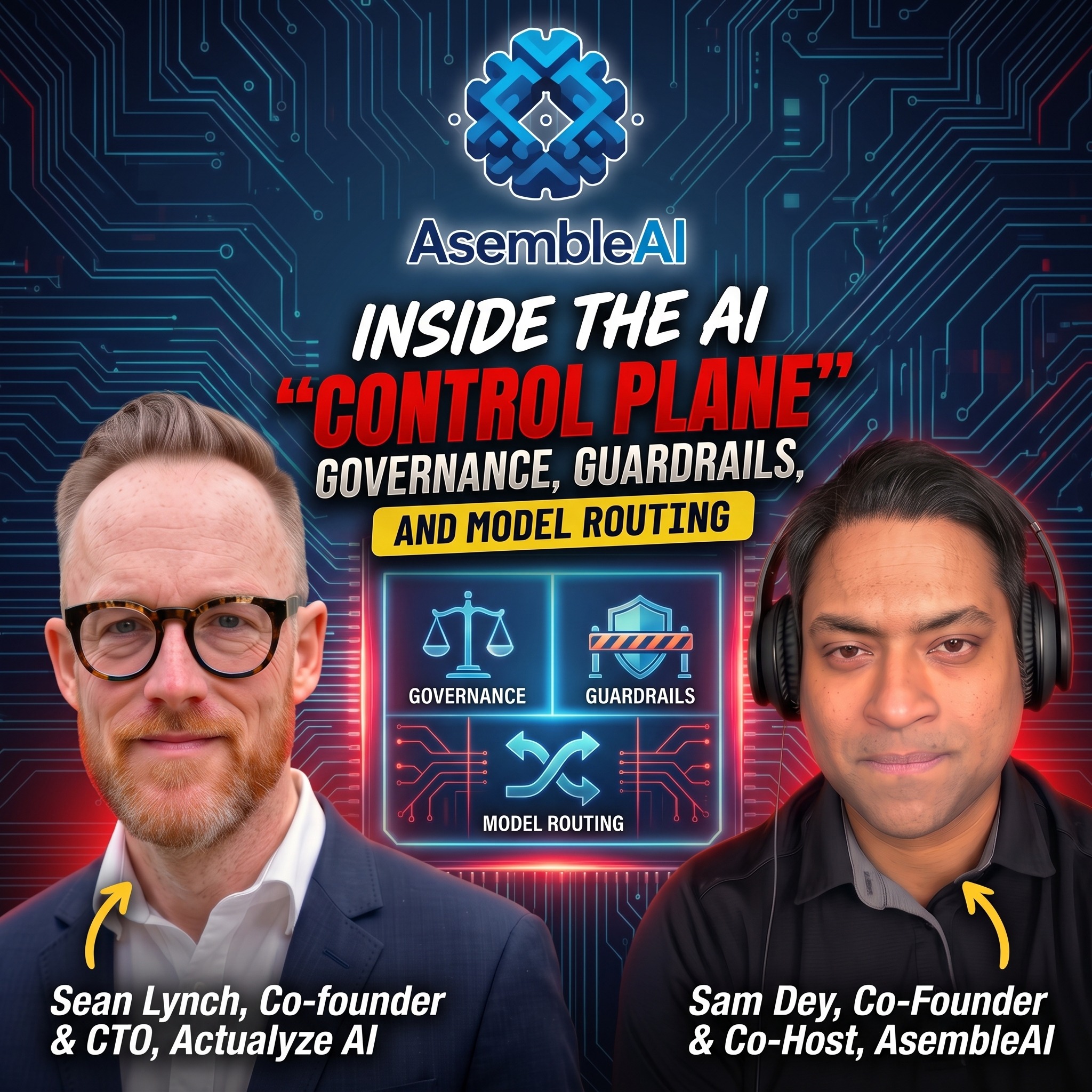
In this 21-minute episode, host Sam interviews Sean Lynch, Co-Founder and CTO of ActualyzeAI, a newly launched enterprise AI governance platform. The conversation centers on ActualyzeAI's core offering: a "control plane" that sits between enterprise applications and multiple AI models, providing centralized…
Worth it if you're an enterprise architect evaluating AI governance platforms, a FinOps leader managing AI infrastructure costs, or someone tracking the emerging control-plane category in enterprise AI.
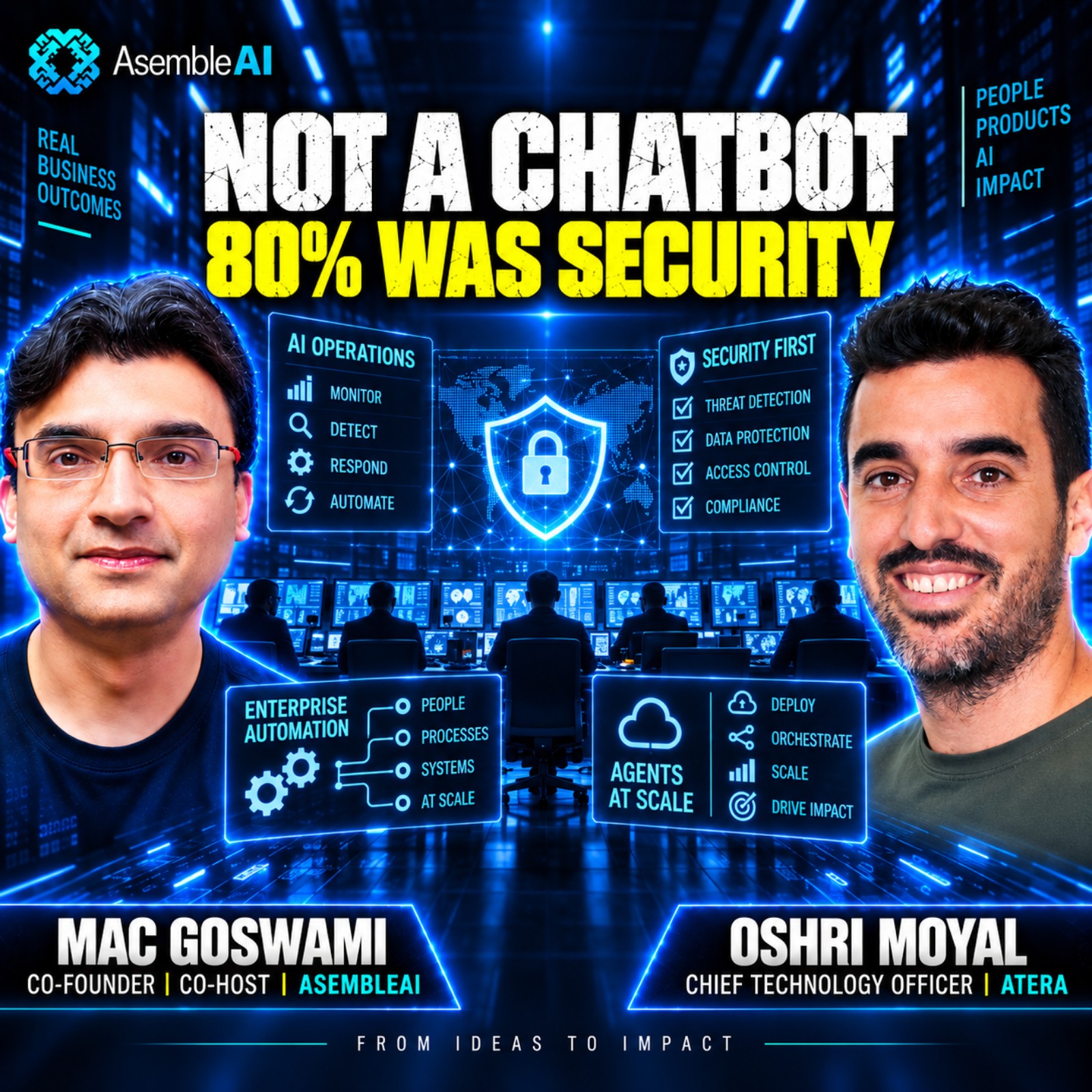
Host Mac Goswami interviews Oshri Moyal, CTO and co-founder of Atera, about Robin, an autonomous IT agent that recently ranked #1 across 15 G2 Summer 2026 reports. Unlike chatbots, Robin actually executes IT tasks end-to-end: navigating networks, logging into servers, and taking real action within policy and approval…
Worth it if you manage IT operations, evaluate automation tools, or want a practical overview of how autonomous agents are moving beyond chatbots into real ticket resolution.
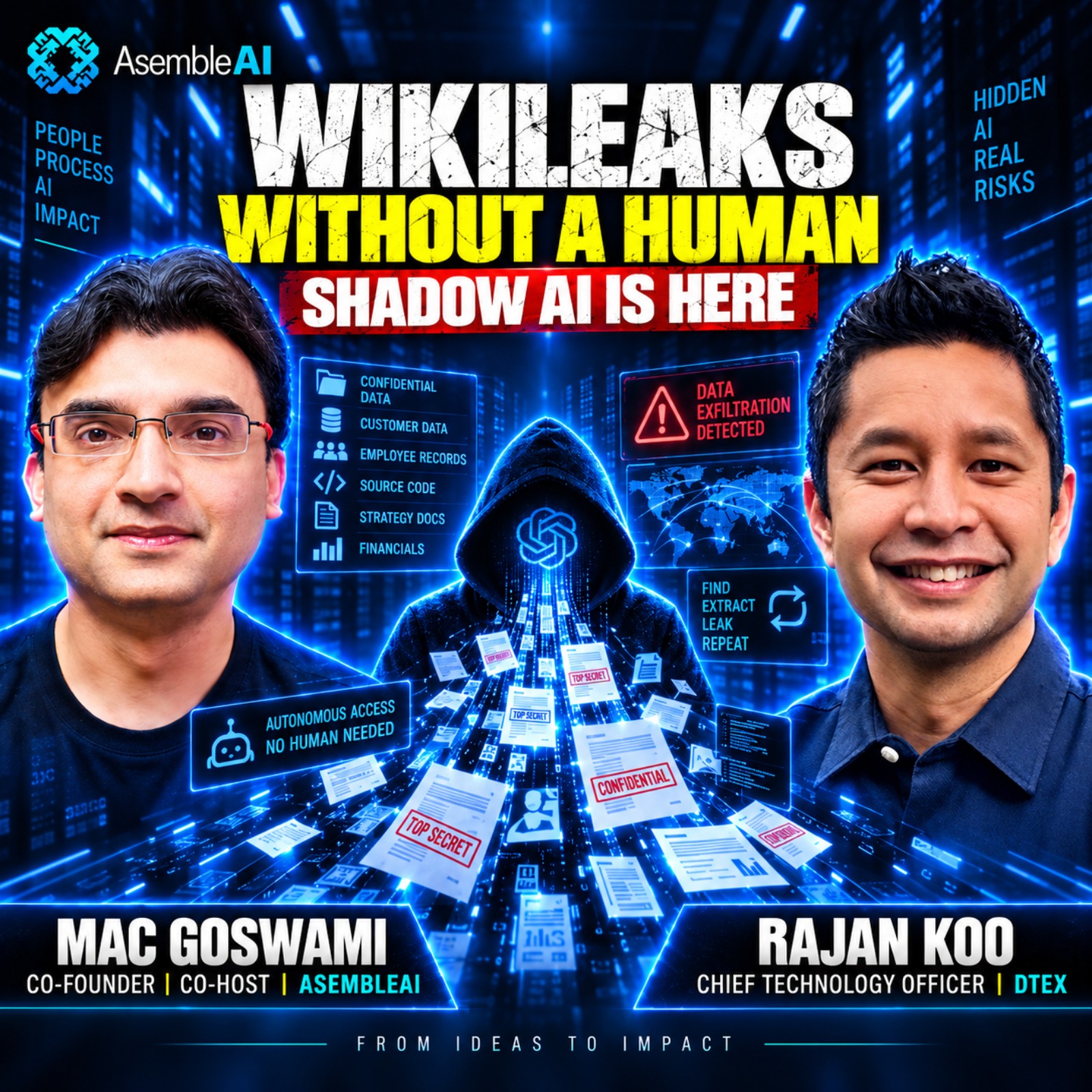
Inside AsembleAI's 25-minute episode features Rajan Koo, CTO of DTEX Systems, discussing how AI has fundamentally transformed insider-threat risks. Recorded live at the AI4 conference, the conversation centers on a paradigm shift: insider threats no longer require human malice or intent. Koo opens with the evolution…
Worth it if you work in cybersecurity, risk management, or AI governance and want to understand how autonomous AI systems are reshaping insider-threat models.

Chris Kudla, co-founder and CEO of Mind Children, discusses the company's bet on social robotics—a harder but potentially more impactful path than industrial automation. The episode covers why Mind Children chose education, healthcare, and hospitality applications where emotional connection matters alongside function.…
Worth it if you're curious about social robotics, AI applications beyond automation, or early-stage deeptech startups—or if you're considering backing Mind Children's crowdfunding.