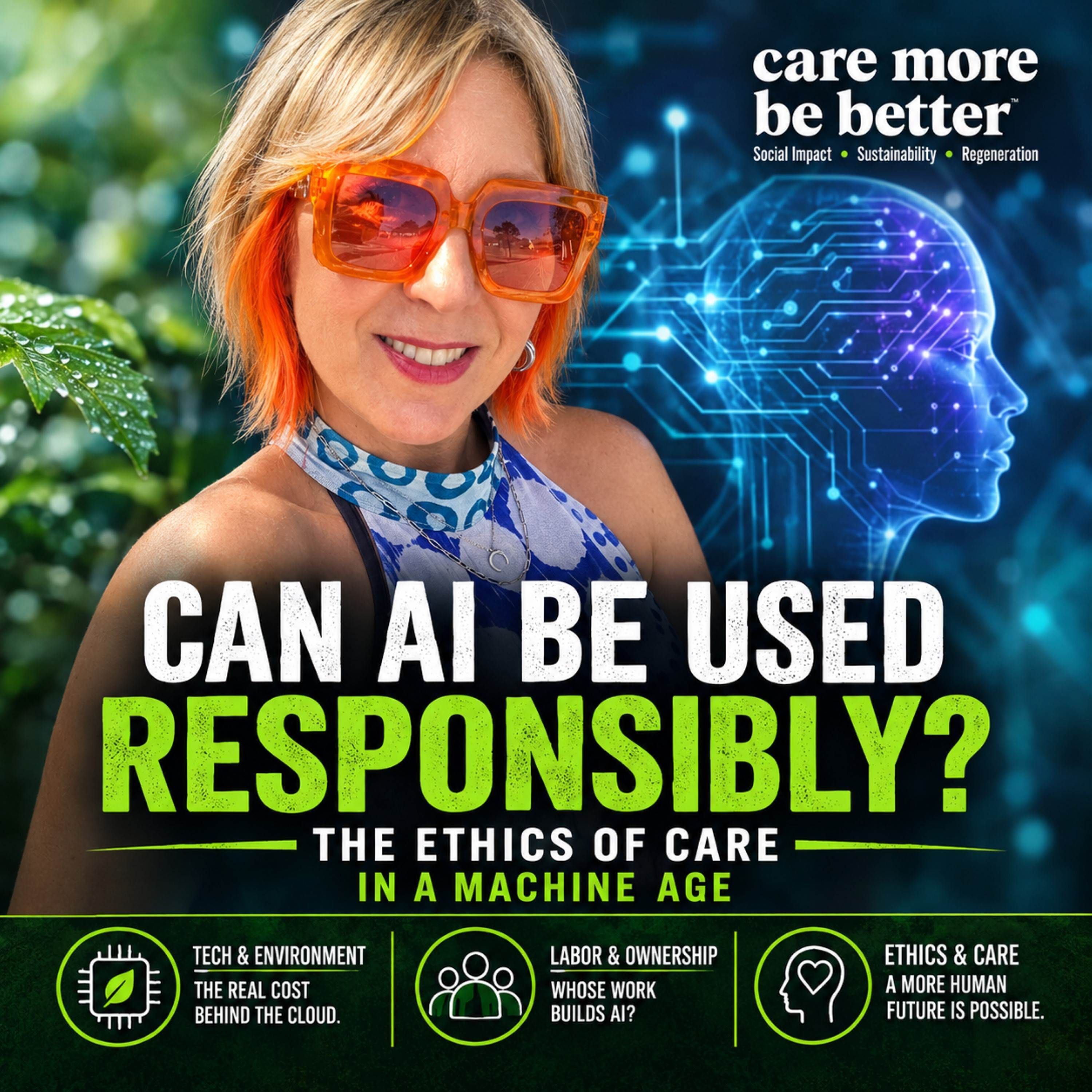
Can AI Be Used Responsibly? The Ethics of Care in a Machine Age with Corinna Bellizzi, PhD, MBA
Evaluation and Summary
Host Corinna Bellizzi delivers a solo episode reframing AI ethics through the lens of care rather than power. Drawing on Carol Gilligan's ethics of care tradition and her own doctoral research into regenerative enterprise, Bellizzi argues that AI can amplify care—but only with intention, transparency, and accountability. The episode opens with a foundational question: what does it mean to care when machines mediate learning? Bellizzi explains ethics of care as a framework that moves beyond rules and regulations to ask who is affected and what they need. She positions this as nearly synonymous with regeneration. She then identifies four major care questions AI raises: copyright (discussing Anthropic's $1.5B settlement with authors and 35+ active cases), ecology (water and energy consumption, community impact of data centers), labor (whose words trained models), and attention (what happens to wonder when answers arrive instantly). She illustrates the attention question with a personal anecdote about "the whale bends story"—something lost when instant answers replace discovery. Bellizzi shares practical experience using Claude and ChatGPT in dissertation research, contrasting the two tools' hallucination problems. She uses the RFK Jr. MAHA report as a cautionary example of AI-generated misinformation that went unchecked, then describes using Claude responsibly for editing academic work without outsourcing thinking. The episode addresses disclosure, noting her website disclaimer about AI use in podcast production. She positions AI as an amplifier—of care or carelessness depending on intention—and offers four questions listeners should ask before adopting any AI tool (not detailed in show notes). Bellizzi emphasizes the freedom not to use AI and closes by framing technology adoption as a matter of personal integrity: care first, then better outcomes. The episode is grounded in academic philosophy (Gilligan, Noddings, Held) and current events (copyright settlements, hallucinations), with personal application throughout. The structure moves from theory to specific cases to practical guidance.
Verdict: A thoughtful, well-structured episode that brings a genuinely fresh philosophical lens to AI ethics, grounded in real cases and personal experience, with clear practical takeaways—ideal for listeners seeking depth beyond hype.
Science rubric
-
Scientific accuracy 4/5 20%
Grounded in established ethics frameworks (Gilligan, Noddings, Held) and real events (Anthropic settlement, MAHA report); acknowledges hallucination problems without overstating AI capabilities; avoids hype.
-
Clarity for non-experts 4/5 20%
Explains ethics of care accessibly, uses concrete examples (whale bends story, RFK report), and moves logically from theory to application; assumes some familiarity with AI but doesn't require it.
-
Sense of discovery 4/5 15%
Reframing AI ethics through care rather than power is a genuinely fresh angle; most AI discourse focuses on disruption and capability, not relational responsibility; personal research examples add originality.
-
Substance 4/5 15%
Dense with ideas: four distinct care questions, philosophical grounding, real-world cases, personal application, and practical guidance; structured progression from theory to practice without apparent filler.
-
Delivers on its title 5/5 15%
Title promises exploration of responsible AI use and ethics of care; episode delivers exactly that, covering both the philosophical framework and practical implementation throughout.
-
Value for time 4/5 15%
22 minutes is tight for the material covered; chapter markers suggest efficient pacing; no obvious padding evident from show notes, though compression may limit depth on some topics.
Worth it if you want to move beyond AI fear-mongering or cheerleading and explore what responsible, intentional use actually means through a care-centered ethical framework.
Based on the episode description. AI-generated; it can be wrong.
Show notes
More from Care More Be Better: A Podcast For Sustainable Social Impact and Regeneration

This episode features Coach Bill Hogarty, a former competitive bodybuilder and founder of the Kids Diabetes Foundation, in conversation with host Corinna about childhood health, insulin resistance, and the counterproductive role of shame in family wellness. Hogarty's arc—from peak athletic condition to weight gain…
Worth it if you're a parent concerned about childhood metabolic health, skeptical of diet culture, or seeking compassion-centered approaches to family wellness.

This 59-minute episode features Monica Sanders, a Georgetown Law professor, author, and founder of The Undivide Project, discussing her book 'Climate and Code' and the intersection of digital access, climate resilience, and disaster equity. Sanders, a Hurricane Katrina survivor, brings personal and professional…
Worth it if you care about climate justice, disaster resilience, digital equity, or how technology can serve marginalized communities—or if you want to understand why digital infrastructure matters during environmental crises.