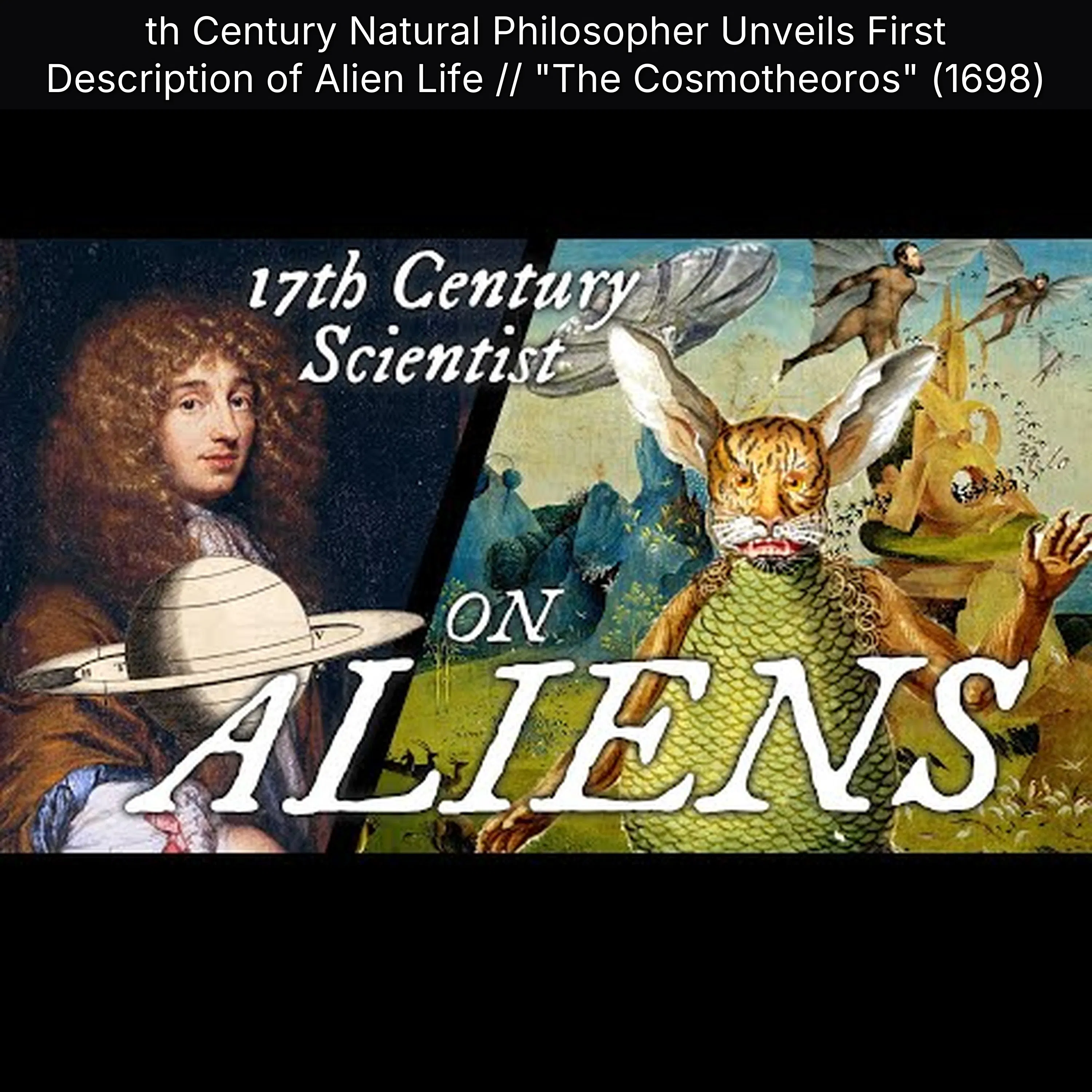
th Century Natural Philosopher Unveils First Description of Alien Life // "The Cosmotheoros" (1698)
Evaluation and Summary
This 18-minute episode from History's Living Voices presents excerpts from Christiaan Huygens's 1698 work 'The Cosmotheoros' (full title: 'The Celestial Worlds Discover'd, or, Conjectures concerning the Inhabitants, Plants and Productions of the Worlds in the Planets'). The episode appears to feature direct readings or translations from Huygens's Latin text, exploring his speculative ideas about extraterrestrial life on other planets. Huygens, a 17th-century natural philosopher and astronomer, presents conjectures about what kinds of beings, plants, and productions might exist on distant worlds—making this one of the earliest European scientific speculations about alien life. The episode frames this as a historical document read by someone from the past era, fitting the show's format of presenting primary historical sources. The production includes licensed soundtrack music and stock footage to accompany the readings. A significant portion of the show notes is devoted to promoting MagellanTV, a documentary streaming service offering a free trial, which appears to be a sponsor or partner of the episode.
Verdict: A solid historical document presentation that delivers exactly what its title promises, but limited by reliance on primary source readings alone without apparent expert context or deeper analysis.
Education rubric
-
Clarity of explanation 3/5 20%
The source material suggests direct excerpts from a 17th-century Latin text are being read; clarity depends on translation quality and presentation, which cannot be fully assessed from notes alone, but the framing as 'conjectures' suggests
-
Accuracy 4/5 20%
The episode draws directly from Huygens's actual published work with proper attribution and translation credit; the historical document itself is authentic, though the accuracy of any editorial framing or commentary cannot be verified from
-
Structure 3/5 15%
The episode appears to be organized as readings from a single primary source with thematic coherence (inhabitants, plants, productions of worlds), but the structural approach—whether it builds an argument or simply presents excerpts—is uncl
-
Substance 3/5 15%
An 18-minute episode reading from a historical text offers moderate substance; the show notes provide no indication of additional analysis, context, or expert commentary beyond the source material itself, suggesting the episode may rely hea
-
Delivers on its title 5/5 15%
The title promises 'First Description of Alien Life' from 'The Cosmotheoros,' and the episode delivers exactly that—direct excerpts from Huygens's 1698 work on extraterrestrial life.
-
Value for time 3/5 15%
An 18-minute episode reading historical excerpts offers reasonable pacing for the format, though without evidence of additional context or analysis, the value depends entirely on listener interest in the primary source itself.
Worth it if you're interested in early modern scientific speculation about extraterrestrial life or enjoy primary historical sources read aloud with period-appropriate production.
Content flags
- Ad-heavy Substantial portion of show notes devoted to MagellanTV sponsorship/free trial promotion, suggesting significant advertising presence relative to 18-minute episode length.
Based on the episode description. AI-generated; it can be wrong.
Show notes
More from History's Living Voices: The Past, Told by Those Who Lived It

This 23-minute episode presents primary source accounts from participants in the First Crusade (1096), drawing from two scholarly compilations: August C. Krey's 'The First Crusade: The Accounts of Eye-Witnesses and Participants' (1921) and Martha Evelyn McGinty's translation of Fulcher of Chartres' 'Chronicle of the…
Worth it if you want authentic medieval crusade accounts and don't mind commercial breaks interrupting a short documentary-style piece.

This 4-minute episode from History's Living Voices presents Tacitus' account of Christians from his Annals, written around 116 AD. The show notes indicate the episode features the oldest surviving Roman reference to Christianity, specifically Tacitus' description of Nero's persecution of Christians in 65 AD. According…
Worth it if you want a quick exposure to Tacitus' actual words on early Christianity, but not if you seek substantive historical analysis or context.

This episode presents an audio reading of the opening section of Procopius of Caesarea's 'History of the Wars of Justinian', a sixth-century historical text that documents the military campaigns of Byzantine Emperor Justinian I (r. 527–565). The episode is part of History Time's 'Living Voices' series, which aims to…
Worth it if you want to hear Procopius's own words read aloud and are already familiar with Late Antique history, or if you prefer unmediated primary sources over expert commentary.

This documentary traces Japan's rapid transformation from an isolated feudal society to a major world power between 1865 and 1905—a 40-year span that fundamentally reshaped the nation. The episode is structured chronologically through key phases: the end of the Edo period and opening to the world, Japan's initial…
Worth it if you want a comprehensive, academically-grounded overview of Japan's Meiji-era transformation and are comfortable with a straightforward documentary approach to history.

This 21-minute episode features a reading from Fukuzawa Yukichi's autobiography, specifically his first-hand account of visiting Europe after Japan's period of sakoku (forced isolation). The episode presents Fukuzawa's observations of England, France, Holland, and Russia during the 1862 Tokugawa Embassy—a historically…
Worth it if you're interested in Japanese history, cross-cultural perspectives on Western modernization, or primary source material from Japan's transformative Meiji era.

This 14-minute episode from History's Living Voices presents a historical account of Native American perspectives on first contact with Europeans, drawn from John Gottlieb Ernestus Heckewelder's 1770s ethnographic work 'History, manners, and customs of the Indian nations who once inhabited Pennsylvania and the…
Worth it if you're interested in early colonial history, Native American perspectives on European contact, or appreciate primary source material presented in audio form.