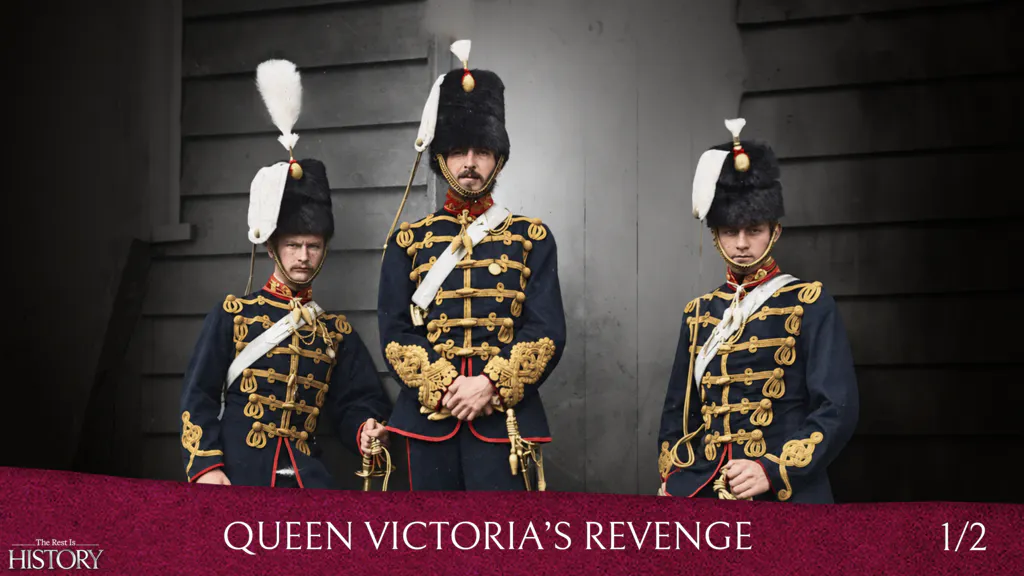
706. Queen Victoria’s Revenge: Storming the Citadel (Part 2)
Evaluation and Summary
This is part two of a two-part series on the 1868 British military expedition to Abyssinia (Ethiopia), led by Lieutenant General Robert Napier. The episode concludes the narrative of the rescue mission to free European hostages held by Emperor Tewodros II at his fortress of Magdala. Based on the description, the episode focuses on Napier's military strategy and planning for the assault on Magdala, the execution of the attack itself, and the ultimate success or failure of the expedition in rescuing the captives and extracting British forces from Abyssinia. Hosts Dominic Sandbrook and Tom Holland guide listeners through this 'epic expedition' in British imperial history, presumably drawing on historical records and military accounts to reconstruct the campaign. The episode is positioned as the climactic conclusion to a compelling historical narrative that began in part one. The show notes emphasize the scale and drama of the undertaking—describing it as 'one of the most epic expeditions in the history of the British Empire'—suggesting the hosts aim to convey both the logistical complexity and the human stakes involved. The episode runs 1 hour 14 minutes, indicating substantial time devoted to the story. No guest historians or specialists are mentioned in the available materials, so the episode appears to rely on the hosts' own expertise and research. The show notes provide minimal detail about specific content, sources, or particular revelations, making it difficult to assess the depth of research or originality beyond the general topic.
Verdict: A likely solid historical narrative from experienced hosts on a genuinely dramatic imperial-era story, but thin source material prevents confident evaluation of research depth, storytelling craft, or whether it avoids oversimplification.
History rubric
-
Research depth n/a
Show notes provide no detail about sources, primary documents, or specific research methods used
-
Storytelling n/a
Cannot assess narrative craft from description alone; no sample dialogue or structural details provided
-
Context and nuance n/a
Show notes do not indicate whether the episode explores multiple perspectives, causes, or complexities of the expedition
-
Substance 3/5 50%
74-minute runtime suggests substantial content, but show notes lack specifics about density of information versus padding
-
Delivers on its title 4/5 50%
Title promises Napier's attack on Magdala and the outcome; description confirms these topics are covered as the conclusion to the story
-
Value for time n/a
Pacing cannot be assessed from show notes alone; runtime is moderate but efficiency unknown
Worth it if you enjoyed part one, enjoy British imperial history told by engaging hosts, or want a narrative account of a little-known 19th-century military campaign.
Based on the episode description. AI-generated; it can be wrong.
Show notes
More from The Rest Is History

This is Part 6 of The Rest Is History's multi-part series on the French Revolution's Reign of Terror, focusing on its climactic conclusion: the fall and execution of Maximilien Robespierre. According to the show notes, the episode addresses three central questions: why the Terror escalated to unprecedented bloodshed…
Worth it if you've followed The Rest Is History's Terror series and want the dramatic conclusion, or if you're interested in the French Revolution's endgame told by experienced popular historians.
Part 5 of The Rest Is History's series on the Terror focuses on one of the French Revolution's most bizarre and revealing episodes: Robespierre's Festival of the Supreme Being in 1794. The episode explores why Robespierre orchestrated this vast, eccentric public spectacle during the height of the Reign of Terror—a…
Worth it if you're following The Rest Is History's Terror series or interested in how revolutionary ideology attempted to reshape religion and belief.
Part 4 of The Rest Is History's series on the French Revolution's Reign of Terror focuses on the dramatic fall of Georges Danton, one of the Revolution's most prominent figures. Hosts Dominic Sandbrook and Tom Holland examine the ideological clash between Danton and Maximilien Robespierre regarding the direction and…
Worth it if you're following The Rest Is History's Terror series, interested in French Revolutionary politics, or fascinated by how revolutionary movements consume their own leaders.
This is part three of The Rest Is History's multi-episode examination of the French Revolution's Terror, focusing specifically on Marie Antoinette's imprisonment, trial, and execution on October 16, 1793. The episode explores the conditions of her captivity—she was imprisoned for over a year following her husband King…
Worth it if you're following The Rest Is History's Terror series or have strong interest in Marie Antoinette and the French Revolution's most dramatic moments.
This is part 2 of a two-part series on Robespierre and the Reign of Terror during the French Revolution, hosted by Tom Holland and Dominic Sandbrook. The episode explores Robespierre's rise from provincial obscurity to becoming one of the most powerful figures of the Revolution, examining the central paradox of his…
Worth it if you're interested in the French Revolution, Robespierre's psychology, or how individuals navigate and shape revolutionary violence.
The Rest Is History launches a two-part series on the Reign of Terror during the French Revolution, with hosts Dominic Sandbrook and Tom Holland exploring how the revolution descended into violence and bloodshed. The episode centers on the murder of Jean-Paul Marat, a radical firebrand of the Revolution, and examines…
Worth it if you're interested in the French Revolution's descent into violence and enjoy accessible historical narrative from knowledgeable hosts.