
711. The Terror: Killing God (Part 5)
Evaluation and Summary
Part 5 of The Rest Is History's series on the Terror focuses on one of the French Revolution's most bizarre and revealing episodes: Robespierre's Festival of the Supreme Being in 1794. The episode explores why Robespierre orchestrated this vast, eccentric public spectacle during the height of the Reign of Terror—a period of mass executions and paranoia. Hosts Tom Holland and Dominic Sandbrook examine what the festival reveals about Robespierre's psychology, his messianic beliefs, and his audacious attempt to replace Christian God with a rationalist civic religion. The episode investigates whether Robespierre genuinely believed the French Revolution could succeed in supplanting Christianity itself, or whether the festival was primarily a propaganda tool to consolidate power. The hosts discuss the festival's sinister reception—how it was perceived by contemporaries and what it tells us about the revolutionary moment. The episode also traces the broader transformation of France during this period, examining how revolutionary ideology attempted to reshape not just politics but spirituality and belief itself. By focusing on this single extraordinary event, the episode uses it as a lens to understand Robespierre's character, his quasi-religious view of the Revolution, and the ultimate contradictions and failures of the Terror. The episode is part of a larger series examining how the Revolution attempted to 'kill God'—to eradicate religious authority and replace it with secular rationalism.
Verdict: A focused, well-targeted episode on a fascinating historical moment that likely delivers on its promise, but source material provides limited evidence of research depth or narrative craft.
History rubric
-
Research depth 3/5 24%
Show notes indicate discussion of a specific historical event with psychological analysis, but no mention of primary sources, archival material, or scholarly citations
-
Storytelling 3/5 24%
Framed around a vivid, dramatic event (the festival itself), but notes don't indicate whether the narrative is compellingly told or remains expository
-
Context and nuance 3/5 18%
Notes suggest exploration of Robespierre's beliefs and the festival's reception, indicating some nuance, but the framing questions suggest some binary thinking (did he 'really believe')
-
Substance 3/5 18%
Focused episode on a single event with psychological and ideological dimensions; solid content but limited scope prevents assessment of density
-
Delivers on its title 5/5 18%
Title promises examination of the festival and its connection to killing God; description directly addresses the festival, Robespierre's psychology, and revolutionary theology
-
Value for time n/a
No information about pacing, structure, or whether 77 minutes is appropriate for the material covered
Worth it if you're following The Rest Is History's Terror series or interested in how revolutionary ideology attempted to reshape religion and belief.
Content flags
- Ad-heavy Sponsor read for Anthropic plus partnership advertising in a 77-minute episode
Based on the episode description. AI-generated; it can be wrong.
Show notes
More from The Rest Is History
This is Part 6 of The Rest Is History's multi-part series on the French Revolution's Reign of Terror, focusing on its climactic conclusion: the fall and execution of Maximilien Robespierre. According to the show notes, the episode addresses three central questions: why the Terror escalated to unprecedented bloodshed…
Worth it if you've followed The Rest Is History's Terror series and want the dramatic conclusion, or if you're interested in the French Revolution's endgame told by experienced popular historians.
Part 4 of The Rest Is History's series on the French Revolution's Reign of Terror focuses on the dramatic fall of Georges Danton, one of the Revolution's most prominent figures. Hosts Dominic Sandbrook and Tom Holland examine the ideological clash between Danton and Maximilien Robespierre regarding the direction and…
Worth it if you're following The Rest Is History's Terror series, interested in French Revolutionary politics, or fascinated by how revolutionary movements consume their own leaders.
This is part three of The Rest Is History's multi-episode examination of the French Revolution's Terror, focusing specifically on Marie Antoinette's imprisonment, trial, and execution on October 16, 1793. The episode explores the conditions of her captivity—she was imprisoned for over a year following her husband King…
Worth it if you're following The Rest Is History's Terror series or have strong interest in Marie Antoinette and the French Revolution's most dramatic moments.
This is part 2 of a two-part series on Robespierre and the Reign of Terror during the French Revolution, hosted by Tom Holland and Dominic Sandbrook. The episode explores Robespierre's rise from provincial obscurity to becoming one of the most powerful figures of the Revolution, examining the central paradox of his…
Worth it if you're interested in the French Revolution, Robespierre's psychology, or how individuals navigate and shape revolutionary violence.
The Rest Is History launches a two-part series on the Reign of Terror during the French Revolution, with hosts Dominic Sandbrook and Tom Holland exploring how the revolution descended into violence and bloodshed. The episode centers on the murder of Jean-Paul Marat, a radical firebrand of the Revolution, and examines…
Worth it if you're interested in the French Revolution's descent into violence and enjoy accessible historical narrative from knowledgeable hosts.
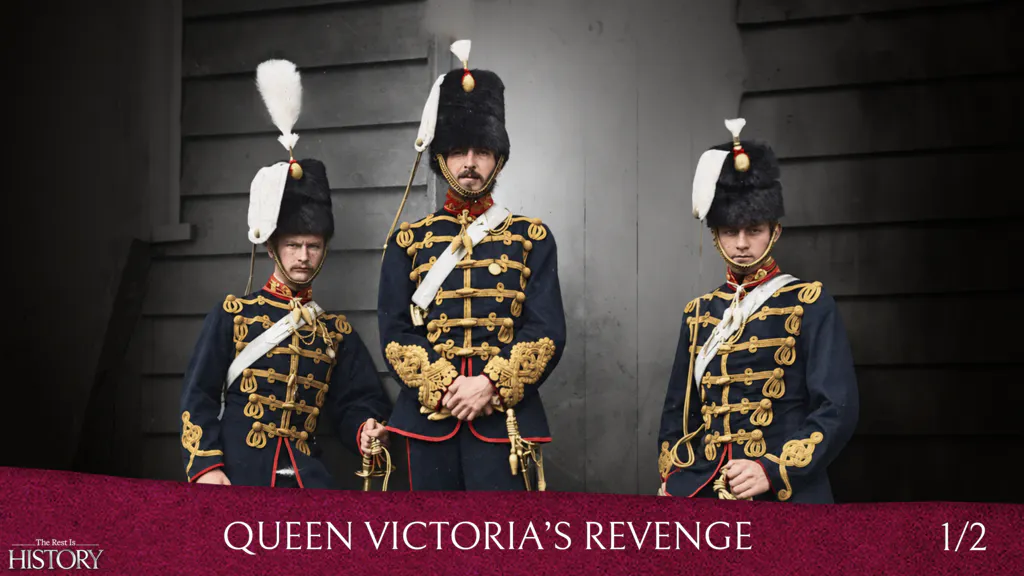
This is part two of a two-part series on the 1868 British military expedition to Abyssinia (Ethiopia), led by Lieutenant General Robert Napier. The episode concludes the narrative of the rescue mission to free European hostages held by Emperor Tewodros II at his fortress of Magdala. Based on the description, the…
Worth it if you enjoyed part one, enjoy British imperial history told by engaging hosts, or want a narrative account of a little-known 19th-century military campaign.