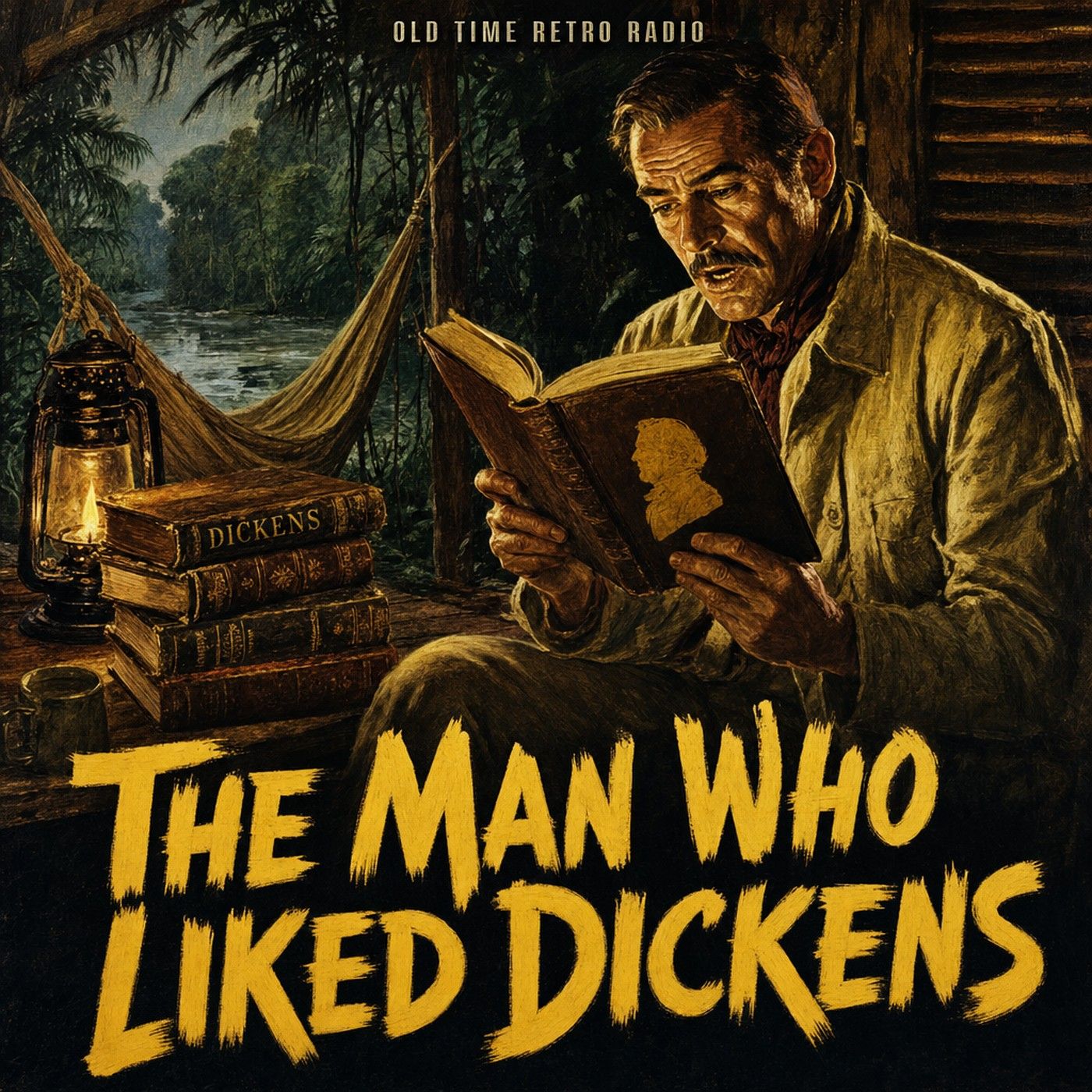
Escape - "The Man Who Liked Dickens" (Old Time Radio)
Evaluation and Summary
This is a restored broadcast of 'The Man Who Liked Dickens,' a 1952 CBS radio drama adapted by John Meston from Evelyn Waugh's 1933 short story. The episode stars Terry Kilburn as Paul Henty, an English traveler weakened and lost in the remote Brazilian jungle who stumbles upon the isolated dwelling of Mr. McMaster (Joseph Kearns). What begins as a rescue becomes something far more unsettling: McMaster's obsessive devotion to Charles Dickens and his peculiar hospitality trap Henty in an increasingly claustrophobic psychological situation. The story explores themes of isolation, cultural displacement, and the dark irony of survival through the lens of literary obsession. The production is directed and produced by Antony Ellis and features newly mastered audio to enhance clarity while preserving the original 1952 broadcast quality. The episode includes a contextual introduction by Victor Sterling and a closing announcement, bookending the 29-minute original drama.
Verdict: A well-crafted adaptation of literary source material with strong performances and production values that delivers psychological tension and thematic substance in a tight radio drama format.
Fiction rubric
-
Writing 4/5 20%
Adapted from a respected Evelyn Waugh short story by experienced radio writer John Meston; the premise suggests sharp, darkly ironic dialogue exploring psychological tension rather than melodrama.
-
Performance and production 4/5 20%
Directed by Antony Ellis with established radio actors Kilburn and Kearns; newly mastered audio indicates professional restoration; production values suggest immersive period radio craftsmanship.
-
Plot momentum 4/5 15%
The setup of a traveler finding refuge that becomes a trap, combined with psychological tension around obsessive behavior, suggests escalating stakes and forward momentum through a 30-minute runtime.
-
Substance 4/5 15%
Waugh's source material is known for thematic depth; the story engages with colonialism, cultural isolation, and the power of literature—substantive ideas beyond simple survival narrative.
-
Delivers on its title 5/5 15%
Title directly references the central character and his defining trait; the episode explicitly centers on McMaster's Dickens obsession as the core conflict.
-
Value for time 4/5 15%
30-minute runtime is standard for classic radio drama; the tight format and psychological focus suggest efficient pacing without filler, though source material doesn't confirm exact pacing.
Worth it if you enjoy classic radio drama, psychological thrillers, or Evelyn Waugh's darkly ironic storytelling.
Based on the episode description. AI-generated; it can be wrong.
Show notes
More from Escape | Old Time Radio
This is a restored broadcast of 'Escape,' a classic CBS radio drama from 1948 featuring a seafaring adventure story. The episode, titled 'Misfortunes Isle ALT2,' is adapted by Les Crutchfield from Richard Matthews Hallet's short story and originally aired on March 21, 1948. The production is helmed by William N.…
Worth it if you enjoy vintage radio drama, maritime adventure, or want to experience well-preserved 1940s CBS productions with professional voice acting.
This is a restored broadcast of 'The Country of the Blind,' a 1949 CBS radio adaptation of H.G. Wells's classic science fiction story. The episode follows Juan Nuñez, a mountain guide played by Edmond O'Brien, who survives a treacherous journey through Ecuador's high Andes mountains. After his ordeal, Nuñez stumbles…
Worth it if you enjoy classic science fiction, golden-age radio drama, or H.G. Wells's exploration of perception and human difference.
This episode of Escape presents "The Return," a 1954 CBS radio drama written by Kathleen Hite and directed by Norman Macdonnell, featuring Lawrence Dobkin and William Conrad. The story is set in a walled North African city and follows a weary traveler who confides in a blind beggar about his desire to escape hardship…
Worth it if you appreciate vintage radio drama, philosophical narratives, or want to experience a polished example of 1950s CBS storytelling.