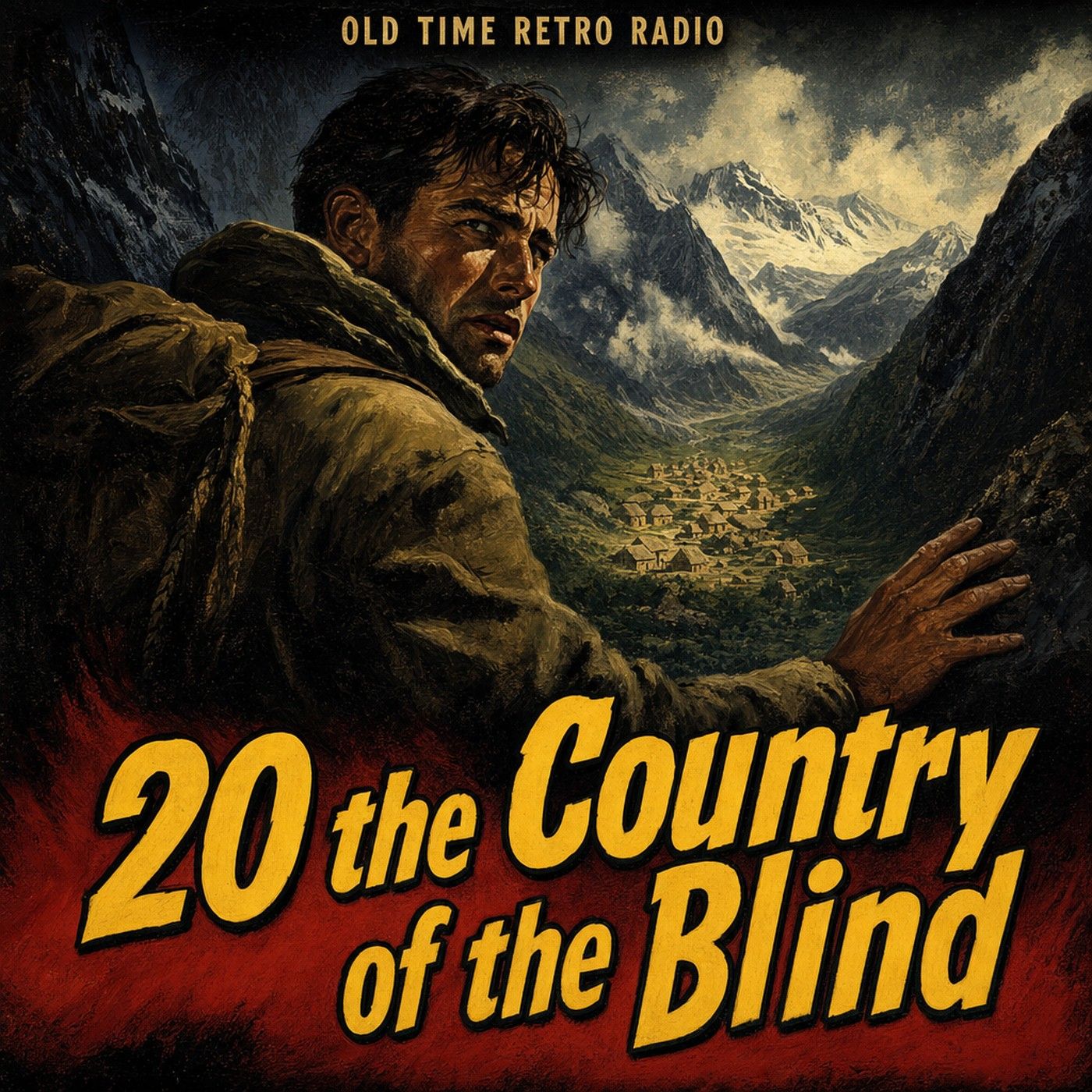
Escape - "20 the Country of the Blind" (Old Time Radio)
Evaluation and Summary
This is a restored broadcast of 'The Country of the Blind,' a 1949 CBS radio adaptation of H.G. Wells's classic science fiction story. The episode follows Juan Nuñez, a mountain guide played by Edmond O'Brien, who survives a treacherous journey through Ecuador's high Andes mountains. After his ordeal, Nuñez stumbles upon an isolated valley community whose inhabitants are all blind—and whose entire worldview and understanding of reality is fundamentally different from his own. The story becomes a philosophical exploration of perception, knowledge, and what it means to belong. The narrative centers on Nuñez's attempts to communicate with and understand this society, and the tension between his sighted perspective and their blind one. The episode features supporting performances by Berry Kroeger and Peggy Webber. The production is a period piece from radio's golden age, directed by Norman Macdonnell and written by John Dunkel. The modern release includes a newly recorded contextual introduction by Victor Sterling, audio restoration and mastering to improve clarity and consistency, and a brief closing announcement. The total runtime is 31 minutes, with the original broadcast occupying roughly 30 minutes of that. This is a faithful presentation of a classic adaptation rather than a new creation, offering listeners a window into how mid-century radio dramatized literary science fiction.
Verdict: A thoughtful adaptation of a literary classic with solid performances and genuine philosophical substance, elevated by careful restoration and framing for modern listeners.
Fiction rubric
-
Writing 3/5 20%
Period radio adaptation of a Wells classic; competent but constrained by 1949 conventions and the source material's philosophical bent rather than dramatic fireworks.
-
Performance and production 3/5 20%
Edmond O'Brien and supporting cast deliver serviceable performances typical of golden-age radio; restored audio is cleaner but the original production values are mid-century standard.
-
Plot momentum 3/5 15%
The premise is intriguing and the story moves forward, but a philosophical tale about perception and belonging may have slower pacing than action-driven radio drama.
-
Substance 4/5 15%
Wells's story carries genuine thematic weight about knowledge, perspective, and social integration; the adaptation preserves the intellectual content alongside the adventure.
-
Delivers on its title 5/5 15%
Directly adapts the Wells story promised in the title; the country of the blind and its implications are the core of the narrative.
-
Value for time 4/5 15%
31 minutes is well-suited to the story; the restoration and introduction add context without padding, though the pacing reflects 1949 radio conventions.
Worth it if you enjoy classic science fiction, golden-age radio drama, or H.G. Wells's exploration of perception and human difference.
Based on the episode description. AI-generated; it can be wrong.
Show notes
More from Escape | Old Time Radio
This is a restored broadcast of 'The Man Who Liked Dickens,' a 1952 CBS radio drama adapted by John Meston from Evelyn Waugh's 1933 short story. The episode stars Terry Kilburn as Paul Henty, an English traveler weakened and lost in the remote Brazilian jungle who stumbles upon the isolated dwelling of Mr. McMaster…
Worth it if you enjoy classic radio drama, psychological thrillers, or Evelyn Waugh's darkly ironic storytelling.
This is a restored broadcast of 'Escape,' a classic CBS radio drama from 1948 featuring a seafaring adventure story. The episode, titled 'Misfortunes Isle ALT2,' is adapted by Les Crutchfield from Richard Matthews Hallet's short story and originally aired on March 21, 1948. The production is helmed by William N.…
Worth it if you enjoy vintage radio drama, maritime adventure, or want to experience well-preserved 1940s CBS productions with professional voice acting.
This episode of Escape presents "The Return," a 1954 CBS radio drama written by Kathleen Hite and directed by Norman Macdonnell, featuring Lawrence Dobkin and William Conrad. The story is set in a walled North African city and follows a weary traveler who confides in a blind beggar about his desire to escape hardship…
Worth it if you appreciate vintage radio drama, philosophical narratives, or want to experience a polished example of 1950s CBS storytelling.