Your AI Produced 10,000 Things. Now What?
Evaluation and Summary
This 22-minute episode tackles a critical problem in AI adoption: companies generating massive volumes of AI output that produces no measurable business value. The hosts frame this as "AI theatre"—outputs created primarily to demonstrate that AI tools are working rather than to solve real problems. The episode centers on part two of a larger theme called "The $20 Employee," examining why AI usage intensity doesn't correlate with business results. The core argument rests on a 69-page OpenAI study of its own customers, which found no meaningful link between how heavily companies use AI and their revenue per employee. This finding challenges the productivity narrative that dominates AI adoption discussions. The hosts illustrate the problem with concrete examples: US Cryotherapy increased headcount from 8 to 12 while using AI primarily as a thinking tool (with revenue gains), and Gusto's analysis of 100,000 small firms showed that 10 percentage points more AI exposure correlated with only 2.2% more revenue—a negligible return. The episode identifies two critical metrics that actually matter: net revenue per person and what employees do with the time AI frees up. The key insight is that AI works best when pointed at expensive, slow judgment calls—the same $20 cost as theatre, but with actual business impact. The implication is that many companies are wasting resources on low-value AI outputs (reports nobody reads, summaries nobody needs, weekly metrics on "hours saved") while missing opportunities to apply AI where it genuinely moves the needle. The show notes emphasize the particular vulnerability of small teams: a six-person company wasting a year on AI theatre faces far greater proportional damage than a 400-person organization. This frames AI adoption as a risk management problem, not just an opportunity problem. The episode appears data-driven and contrarian, challenging Silicon Valley's productivity-through-automation narrative with empirical evidence. However, the source material provides limited detail on discussion depth, guest expertise, or how thoroughly the hosts explore implementation strategies beyond identifying the problem.
Verdict: A sharp, data-backed episode that challenges AI adoption mythology with concrete evidence and offers a useful reframe (judgment vs. theatre), though limited detail on solutions and implementation depth.
Technology rubric
-
Technical accuracy 4/5 20%
Cites specific OpenAI research and Gusto data with concrete percentages; frames AI capabilities realistically without hype, though limited detail prevents full verification
-
Insight beyond the headlines 4/5 20%
The 'AI theatre' concept and the OpenAI study finding (no correlation between usage and revenue) directly contradict mainstream productivity narratives; original framing of AI as a judgment tool rather than output generator
-
Clarity for non-experts 4/5 15%
Uses accessible language and concrete business examples (Cryotherapy, Gusto); avoids heavy jargon; the core thesis is straightforward without oversimplification
-
Substance 3/5 15%
Grounded in real data and case studies, but show notes suggest limited depth on solutions or implementation; identifies the problem clearly but may lack detailed exploration of how to fix it
-
Delivers on its title 5/5 15%
Title promises guidance on what to do after AI produces massive output; episode directly addresses this with the OpenAI study, revenue-per-employee metric, and the judgment-focused recommendation
-
Value for time 4/5 15%
22 minutes is tight for the scope; data-dense with specific examples and a clear thesis; likely well-paced, though show notes don't confirm whether there's padding or tangents
Worth it if you're running a small business, managing AI adoption, or skeptical of productivity claims around AI tools—especially if you've felt the pressure to deploy AI without seeing results.
Based on the episode description. AI-generated; it can be wrong.
Show notes
More from AI Breakdown
AI Breakdown examines a significant market shift: four major AI models released within 72 hours in October 2026, with the headline story not about improved capabilities but about dramatically reduced pricing. The episode's central thesis is that AI has entered an unprecedented cost-deflation cycle—roughly 47% price…
Worth it if you're a business leader, product manager, or AI strategist who needs to understand how rapidly shifting AI economics are invalidating existing budgets and opening new opportunities.
AI Breakdown examines Amazon's decision to block Meta's shopping agent from its platform, framing it as a pivotal moment in the emerging conflict between AI automation and e-commerce business models. The episode argues that Amazon's move wasn't primarily about capability concerns but about economics: AI agents that…
Worth it if you're interested in AI's impact on retail, e-commerce business models, or the emerging conflict between automation and platform monetization strategies.
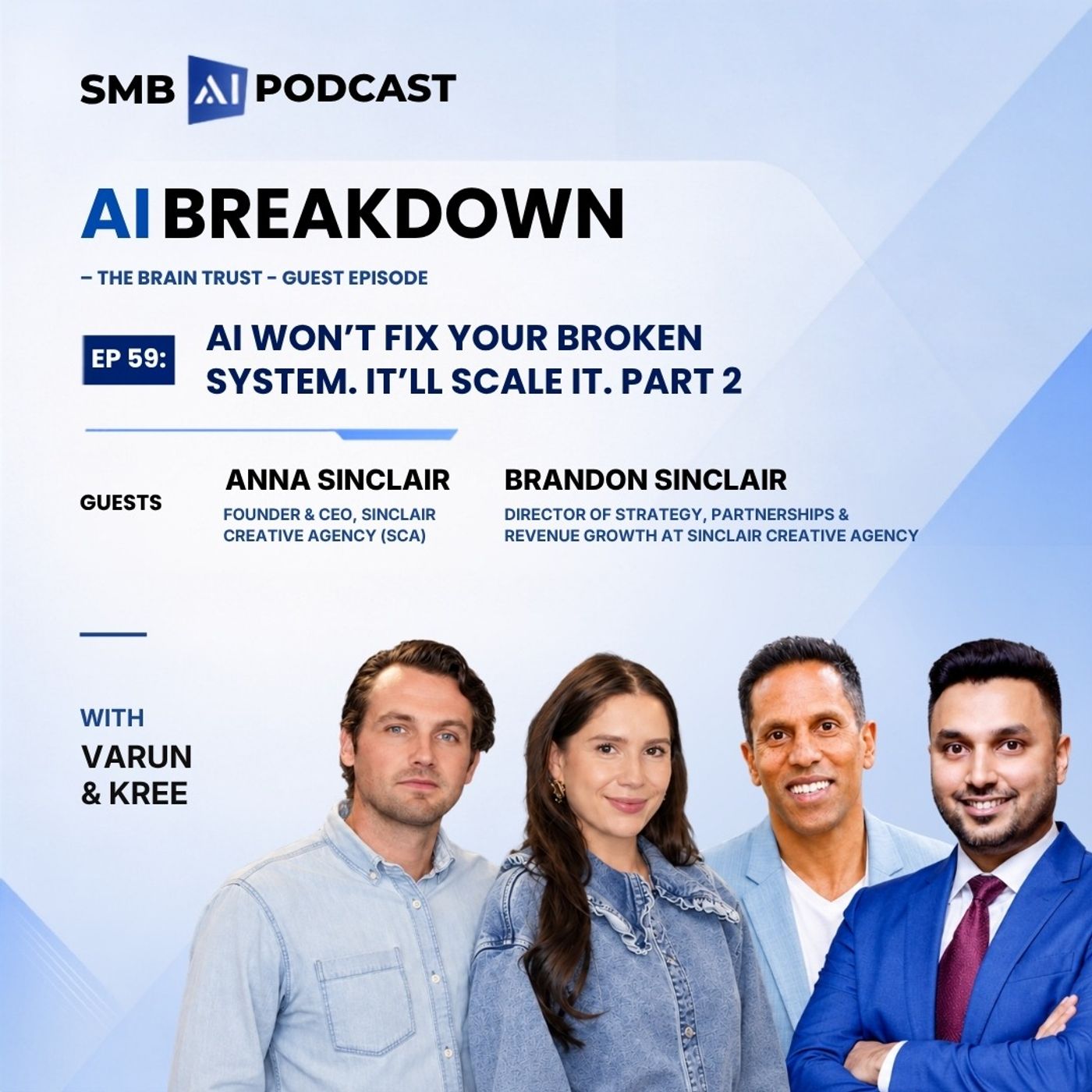
AI Breakdown Part 2 continues a conversation with Anna and Brandon Sinclair, who run a six-person creative agency serving 350+ brands and have deep experience in enterprise revenue systems. The episode frames itself as "the honest half of the conversation," suggesting a more critical, grounded take on AI's actual…
Worth it if you're a small business owner or leader skeptical of AI automation claims and want practical guidance on where AI actually adds value versus where human judgment remains essential.
AI Breakdown examines the financial underpinnings of the AI boom, specifically how cheap AI tools mask an unsustainable debt structure. The episode's central metaphor—a "$20 employee" running on borrowed money—frames the concern that while AI capabilities have improved, the financial markets pricing these companies…
Worth it if you're an AI investor, startup founder, or tech professional concerned with the sustainability of current AI spending and financing trends.