
The Open Accelerator: Turning AI Ideas Into Scalable Companies | Guest Stefanie Chiras
Evaluation and Summary
Building AI Boston hosts Stefanie Chiras, a leader in the newly launched Open Accelerator initiative, to discuss how early-stage AI companies can bridge the gap between prototype and enterprise-ready product. Chiras brings a distinctive background spanning materials science, silicon chip technology, software, and major ecosystem leadership at Red Hat—giving her credibility across the full technology stack. The episode explores why AI has compressed the idea-to-prototype timeline dramatically, but the prototype-to-product journey remains the hard part. The Open Accelerator, a 16-week residency program backed by Red Hat, Massachusetts AI Hub, IBM Ventures, and the broader innovation ecosystem, aims to solve this by providing selected startups with business mentors, technical expertise, enterprise connections, and community support—without requiring equity surrender. Key topics covered include: how open-source principles (shared knowledge, strong communities, clear standards) apply to building AI ecosystems; Chiras's career trajectory and what Red Hat's success in making open-source enterprise-ready teaches AI startups; why Boston and Massachusetts are positioned to become a hub where founders stay to build, not just learn; the practical support the accelerator provides (mentorship, sales expertise, funding connections); and how guardrails around AI experimentation can actually encourage rather than restrict innovation. The conversation frames the accelerator as infrastructure for the post-prototype phase—addressing the ecosystem, expertise, relationships, and community needed to turn viable ideas into viable companies. It touches on the roles government, universities, corporations, investors, and community organizations play in strengthening the AI ecosystem. The episode is fundamentally promotional for the Open Accelerator initiative while using Chiras's experience and perspective to legitimize the program's approach. It promises insight into the prototype-to-product gap and ecosystem-building strategy, and the show notes suggest it delivers on those promises through a knowledgeable guest with relevant experience. However, the material provided doesn't indicate whether the conversation includes specific case studies, concrete metrics, or deep technical discussion—only that it covers the strategic and community-building aspects of the accelerator.
Verdict: A well-positioned guest and relevant topic deliver solid ecosystem-building insight, but the episode functions primarily as an accelerator pitch rather than independent analysis, and the show notes lack evidence of concrete examples or technical depth.
Technology rubric
-
Technical accuracy 3/5 20%
Guest has credible deep tech background (materials science, silicon, software stack, Red Hat), but source material doesn't detail specific technical claims made during the episode to verify accuracy.
-
Insight beyond the headlines 3/5 20%
Offers ecosystem-building perspective and open-source parallels that go beyond surface coverage, but framed largely as a program pitch rather than independent analysis of AI commercialization challenges.
-
Clarity for non-experts 3/5 15%
Topics (prototype-to-product gap, open-source principles, ecosystem building) are accessible, but no evidence in show notes of how technical concepts are explained for general audiences.
-
Substance 3/5 15%
Show notes promise substantive coverage of strategy, history, and ecosystem roles, but lack concrete examples, metrics, or detailed case studies that would indicate dense content throughout.
-
Delivers on its title 4/5 15%
Title focuses on 'Turning AI Ideas Into Scalable Companies' and the episode directly addresses the prototype-to-product gap and the accelerator's role in scaling; fully on-topic.
-
Value for time 3/5 15%
40 minutes is reasonable for a program overview and guest interview, but without episode transcript, pacing and filler cannot be assessed; assume moderate efficiency.
Worth it if you're an AI founder in Massachusetts evaluating accelerator programs, or interested in how open-source principles apply to AI ecosystem development.
Content flags
- Sponsored Episode centers on promoting the Open Accelerator initiative with its leader as guest; functions as program introduction rather than independent journalism.
Based on the episode description. AI-generated; it can be wrong.
Show notes
More from Building AI Boston

Building AI Boston hosts Michael Gilday, founder and CEO of Deep Vibe, to discuss how AI is evolving from a tool into a creative partner in storytelling and world-building. Gilday brings a hybrid background spanning television (including early work on ABC's Lost), advertising, and technology leadership at companies…
Worth it if you're interested in how AI can enhance creative work, the future of interactive storytelling, or Boston's tech ecosystem—especially if you're a creator or technologist exploring collaboration between the two fields.

Building AI Boston interviews Judah Phillips, Chief AI and Product Officer at Market Holdings, about Boston AI Week—a community-driven festival he created to build an AI ecosystem that extends far beyond Boston itself. The episode explores the philosophy and mechanics behind an event that has grown to include 500+…
Worth it if you're interested in how AI communities are built, ecosystem strategy, or how to democratize access to AI opportunities beyond tech insiders.
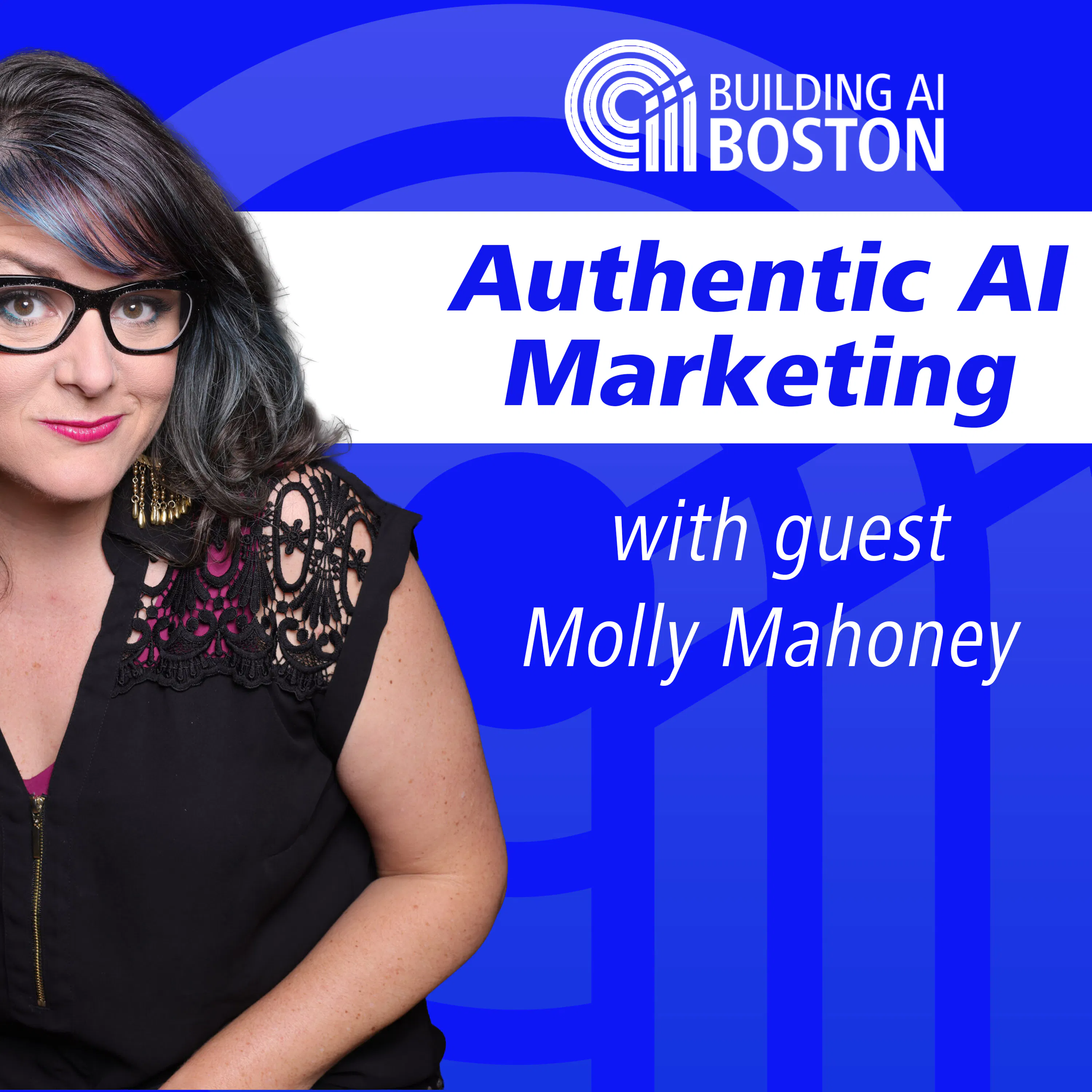
Building AI Boston hosts Anna and Chris interview Molly Mahoney, an AI marketing strategist and entrepreneur known as "The Prepared Performer," to discuss how AI is transforming business marketing and communication. Mahoney has built a following by helping entrepreneurs use AI tools while maintaining authentic voice…
Worth it if you're seeking practical AI marketing tactics and don't mind discovering the specifics by listening rather than reading ahead.