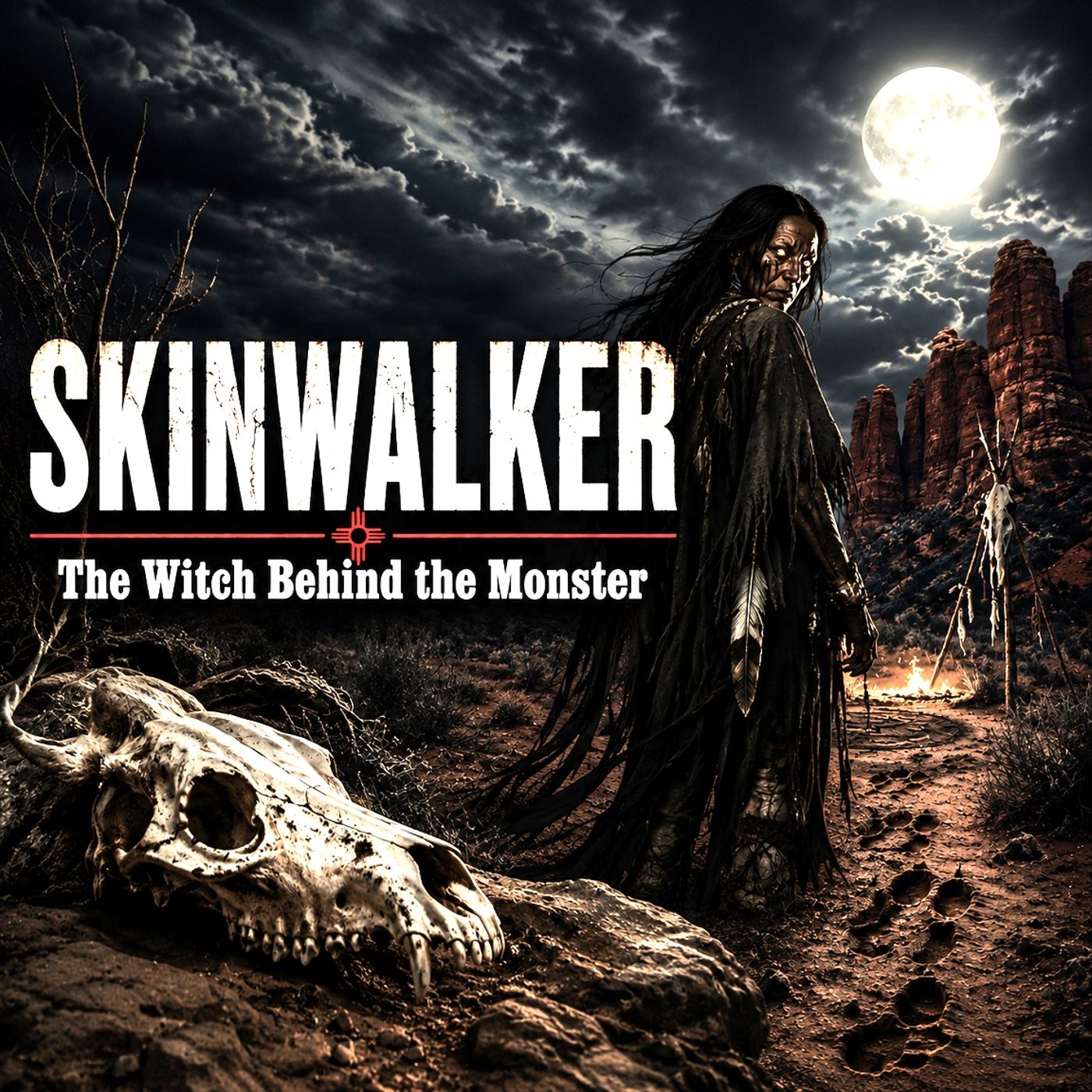
The Occult Rejects episode examines skinwalkers through the lens of Diné (Navajo) culture, witchcraft folklore, and how the legend has evolved in popular media and internet culture. Based on the extensive bibliography provided, the episode appears to trace skinwalkers from their roots in authentic Navajo spiritual traditions and mortuary practices—drawing on foundational anthropological works by Clyde Kluckhohn, William Morgan, and Charlotte Frisbie—through their transformation into contemporary paranormal phenomena. The show notes indicate coverage of how Tony Hillerman's crime novels popularized skinwalker mythology beyond Navajo communities, the sensationalized Skinwalker Ranch reports in Utah, and how digital folklore has further distorted the original cultural concept. The episode also references government documents on anomalous phenomena and journalism critiques (including Indian Country Today's coverage of Ghost Adventures' controversial Navajo episode), suggesting an attempt to distinguish authentic cultural knowledge from modern commercialized versions. The hosts appear to position themselves as researchers engaging with the Occult Research Institute, offering educational content alongside merchandise and community support via Patreon and Cash App. The episode is 76 minutes long, suggesting substantial exploration of these interconnected themes.
Verdict: A well-researched episode that appears to seriously engage with Diné cultural sources while critiquing modern appropriation, though the show notes alone cannot confirm whether the actual audio delivers on this promise with equal rigor.
Religion & Spirituality rubric
Depth of teaching4/520%
Extensive academic bibliography spanning anthropology, folklore studies, and cultural history indicates serious research; covers authentic Diné traditions alongside modern distortions, showing layered understanding.
Respect and openness4/520%
Bibliography includes Navajo-centered sources and references to community criticism (Indian Country Today outrage piece), suggesting engagement with Indigenous perspectives rather than dismissal.
Applicable to life3/515%
Episode appears to teach media literacy and cultural respect regarding appropriation, but show notes don't clarify direct practical takeaways for listeners' daily lives.
Substance4/515%
Rigorous bibliography with 40+ sources spanning anthropology, journalism, folklore, and government documents suggests dense content; 76-minute runtime supports substantive exploration.
Delivers on its title4/515%
Title promises exploration of 'the witch behind the monster'; bibliography structure suggests tracing authentic witchcraft concepts to modern paranormal legend, directly addressing this framing.
Value for time3/515%
76 minutes is substantial; without hearing the episode, unclear if pacing is tight or if tangents pad runtime, but bibliography scope suggests content density justifies length.
Worth it if you're interested in how folklore evolves from authentic cultural traditions into commercialized paranormal entertainment, or want to understand skinwalker mythology beyond pop-culture distortions.
Based on the episode description. AI-generated; it can be wrong.
Show notes
Links For The Occult Rejects
https://linktr.ee/theoccultrejects
Occult Research Institute
https://www.occultresearchinstitute.org/
Substack
https://substack.com/@theoccultrejects?r=7auau0&utm_campaign=profile&utm_medium=profile-page
Cash App
https://cash.app/$theoccultrejects
Venmo
@TheOccultRejects
Patreon
https://www.patreon.com/TheOccultRejects
Bibliography
Diné Culture, Witchcraft, Folklore, and Mortuary Practice
Blue, Martha. The Witch Purge of 1878: Oral and Documentary History in the Early Navajo Reservation Years. Navajo Oral History Monograph Series No. 1. Tsaile, AZ: Navajo Community College Press, 1988.
Brady, Margaret K. Some Kind of Power: Navajo Children’s Skinwalker Narratives. Salt Lake City: University of Utah Press, 1984.
Franciscan Fathers. An Ethnologic Dictionary of the Navaho Language. Saint Michaels, AZ, 1910.
Frisbie, Charlotte J. “On Two William Morgans in Navajo Studies.” New Mexico Historical Review 83, no. 4 (2008): 495–499.
Goddard, Pliny Earle. Navajo Texts. Edited by Gladys A. Reichard. Anthropological Papers of the American Museum of Natural History 34, pt. 1. New York: American Museum of Natural History, 1933.
Kahn-John, Michelle, and Mary Koithan. “Living in Health, Harmony, and Beauty: The Diné (Navajo) Hózhó Wellness Philosophy.” Global Advances in Health and Medicine 4, no. 3 (2015): 24–30. https://doi.org/10.7453/gahmj.2015.044.
Kluckhohn, Clyde. Navaho Witchcraft. Papers of the Peabody Museum of American Archaeology and Ethnology, Harvard University, vol. 22, no. 2. Cambridge, MA: Peabody Museum, 1944.
Levy, Jerrold E. “Changing Burial Practices of the Western Navajo: A Consideration of the Relationship Between Attitudes and Behavior.” American Indian Quarterly 4, no. 4 (1978): 397–405.
Morgan, William. Human-Wolves among the Navaho. Yale University Publications in Anthropology, no. 11. New Haven: Yale University Press, 1936.
Nez, Noah. “Skinwalkers.” Skeptical Briefs 22, no. 1 (2012).
Pavlik, Steve. “Will Big Trotter Reclaim His Place? The Role of the Wolf in Navajo Tradition.” American Indian Culture and Research Journal 24, no. 4 (2000): 107–125. https://doi.org/10.17953/aicr.24.4.p21t105715725434.
Shepardson, Mary. “Changes in Navajo Mortuary Practices and Beliefs.” American Indian Quarterly 4, no. 4 (1978): 383–395.
Popular Literature and the Expansion of the Legend
Hillerman, Tony. Skinwalkers. New York: Harper & Row, 1986.
Kelleher, Colm A., and George Knapp. Hunt for the Skinwalker: Science Confronts the Unexplained at a Remote Ranch in Utah. New York: Paraview Pocket Books, 2005.
Krisst, Rima. “‘Dark Winds’ Hears Critics: Director Says TV Series Will ‘Course-Correct’ for Accuracy.” Navajo Times, June 30, 2022.
Skinwalker Ranch and Contemporary Reporting
Deseret News. “Universe Reports on Strange Utah Occurrences.” December 12, 1996.
Deseret News. “No UFOs or ETs Have Dropped in at ‘Spooky’ Ranch.” April 27, 1997.
Deseret News. “Mysteries of UFO Ranch in Spotlight.” April 22, 2006.
Van Eyck, Zack. “Frequent Fliers?” Deseret News, June 30, 1996.
Government Documents
All-domain Anomaly Resolution Office. Report on the Historical Record of U.S. Government Involvement with Unidentified Anomalous Phenomena, Volume I. Washington, DC: U.S. Department of Defense, 2024.
Defense Intelligence Agency. Advanced Aerospace Weapon System Applications Program Briefing. 2009. Released through the DIA Freedom of Information Act Electronic Reading Room.
Defense Intelligence Agency. Advanced Aerospace Weapon System Applications Program Contract and Related Records. 2008–2012. Released through the DIA Freedom of Information Act Electronic Reading Room.
Digital Folklore and Modern Legend Formation
Blank, Trevor J., ed. Folklore and the Internet: Vernacular Expression in a Digital World. Logan: Utah State University Press, 2009.
Blank, Trevor J., and Robert Glenn Howard, eds. Tradition in the Twenty-First Century: Locating the Role of the Past in the Present. Logan: Utah State University Press, 2013.
Puglia, David J. “Internet and Media in American Folklore and Folklife.” In The Oxford Handbook of American Folklore and Folklife Studies, edited by Simon J. Bronner, 598–624. New York: Oxford University Press, 2019.
Additional Journalism and Public Sources
Indian Country Today. “Many Outraged at Ghost Adventures Navajo ‘SkinWalker’ Episode.” 2017.
Navajo Times. Coverage of Tony Hillerman’s death and his reception among Navajo readers, November 2008.
University of New Mexico Libraries. Tony Hillerman Portal. Bibliographic and archival materials concerning Skinwalkers and Hillerman’s Navajo mystery novels.
Yale University Human Relations Area Files. “Human-Wolves among the Navaho.” eHRAF World Cultures. Scholarly indexing and source evaluation of William Morgan’s study.
Yale University Human Relations Area Files. “Navaho Witchcraft.” eHRAF World Cultures. Scholarly indexing and source evaluation of Clyde Kluckhohn’s
Also want to remind people about the website, if you're into reading we have tons of information by multiple contributors, and we got t-shirts up on the site if you're interested. Fun fact, the art is all based on the eyeball.