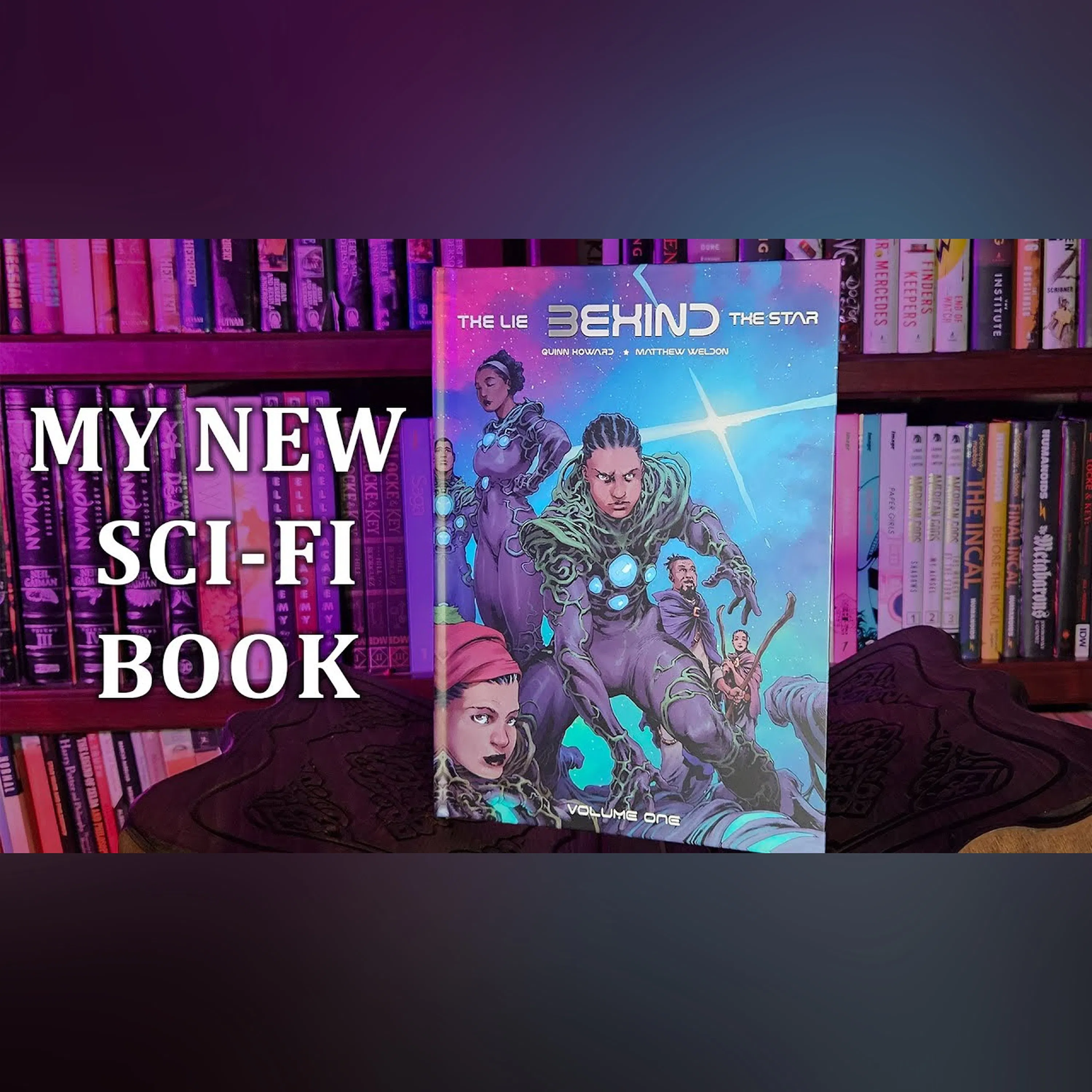
The Lie Behind the Star | Quinn's Graphic Novel
Evaluation and Summary
Quinn's Ideas presents 'The Lie Behind the Star,' a 14-minute episode introducing a graphic novel concept centered on the Waanzilishi, an underground civilization that discovers bioluminescent mushrooms responding to a distant cosmic signal called the Kimora. The episode describes how this civilization evolves from initial discovery through religious and technological advancement, eventually creating three genetically modified beings—The Three Who Are One—who can directly interface with the fungal network and hear the Kimora continuously. These hybrid entities guide the Waanzilishi toward building a vast bio-engineered city and eventually launching a mission to find the source of the signal, believed by many to be a goddess. The narrative blends hard sci-fi concepts (alien signals, biological engineering, space exploration) with mysticism and religious fervor, exploring themes of chosen peoples, technological transcendence, and the search for cosmic meaning. The episode functions primarily as a worldbuilding pitch for Quinn's upcoming graphic novel, with show notes providing extensive supplementary links to artwork, music credits, crowdfunding campaigns (Indiegogo), and related content playlists covering sci-fi classics like Three-Body Problem, Dune, and Hyperion. Quinn appears to be a creator/artist rather than a guest-hosted discussion, positioning this as a creative announcement and call for support rather than analytical commentary on existing work.
Verdict: A well-crafted sci-fi worldbuilding pitch with imaginative concepts that sparks curiosity, but limited by its brief format and lack of critical depth or guest discussion to elevate it beyond a creative announcement.
Arts rubric
-
Insight into the work 3/5 20%
The episode provides detailed worldbuilding and narrative setup but reads more as creative pitch than critical analysis or craft discussion about the graphic novel medium itself.
-
Expertise and access 4/5 20%
Quinn is the creator presenting original work with evident artistic vision, demonstrating clear authority as the author/artist, though the format doesn't showcase deep critical expertise.
-
Sparks curiosity 4/5 15%
The cosmic horror-meets-mysticism premise with bioluminescent fungi and alien signals is imaginative and compelling; the crowdfunding link suggests genuine opportunity to engage further.
-
Substance 3/5 15%
The show notes deliver rich narrative content and worldbuilding detail, but the 14-minute format and pitch-focused structure suggest limited depth beyond the concept itself; no guest discussion or thematic exploration evident.
-
Delivers on its title 4/5 15%
The title 'The Lie Behind the Star' is somewhat cryptic but the episode clearly delivers the core concept and mythology; the 'lie' likely refers to the Kimora's true nature versus religious interpretation, though this remains implicit.
-
Value for time 3/5 15%
At 14 minutes, the episode efficiently conveys the concept, though the format as a creative pitch rather than discussion means limited conversational depth or analysis to justify extended engagement.
Worth it if you enjoy cosmic horror, speculative fiction worldbuilding, or want to support independent graphic novel creators with ambitious sci-fi premises.
Content flags
- Sponsored Episode functions as a crowdfunding pitch with multiple links to Indiegogo campaign, Patreon, and merchandise; primarily promotional for Quinn's graphic novel project.
Based on the episode description. AI-generated; it can be wrong.
Show notes
More from Quinn's Ideas

The episode title promises an analysis of the Bene Gesserit from Dune, but the show notes reveal a significant mismatch. The creator, Quinn, describes this as content about 'A Song of Ice and Fire by George RR Martin'—the Game of Thrones book series—not Frank Herbert's Dune. The show notes explicitly state the episode…
Worth it if you enjoy casual, uninformed speculation about Game of Thrones—but not if you're seeking actual analysis of Dune or the Bene Gesserit.

Quinn's Ideas presents a 4.5-hour deep dive into Cixin Liu's "The Three Body Problem" series, positioning itself as a comprehensive guide covering plot twists, character development, and the science underlying the narrative. The episode is framed as timely given the Netflix adaptation's release, targeting both…
Worth it if you're seeking an accessible introduction to the Three Body Problem series before the Netflix adaptation or want a fan-focused recap of the entire trilogy.

The episode title promises an exploration of 'The Humans of The Culture,' likely referring to Iain M. Banks's acclaimed science fiction series. However, the provided source material contains only boilerplate ad disclosure language and upload metadata with no actual show notes, episode description, guest information,…
Worth it if you're a devoted Iain M. Banks fan willing to take a chance on an episode with no preview information.

The source material provided contains only boilerplate ad disclosure language and upload metadata, with no actual show notes, episode description, guest information, topic outline, or content summary. The episode title 'The Devastating Reason They Visited Earth | You Like It Darker' suggests a discussion potentially…
Worth it if you're already a devoted Quinn's Ideas listener willing to gamble on an episode with zero promotional description.

This episode of Quinn's Ideas examines 'The Wandering Earth,' a science fiction work centered on the premise of the sun dying prematurely. The title 'When The Sun Dies Early' directly references this catastrophic scenario that forms the narrative's core conflict. Based on the episode length of 14 minutes and the…
Worth it if you're already familiar with 'The Wandering Earth' and want a quick thematic discussion, but the lack of descriptive detail makes it impossible to recommend confidently.

Quinn's Ideas presents a 9-minute episode titled "Stephen King's It: When It Wakes | What It Really Eats," promising analysis of the horror novel's central entity. However, the show notes reveal a significant mismatch: the description and social media links reference "A Song of Ice and Fire" by George R.R. Martin, not…
Worth it if you're a completist A Song of Ice and Fire fan looking for casual fan theories, but not if you expect Stephen King analysis or expert insight.