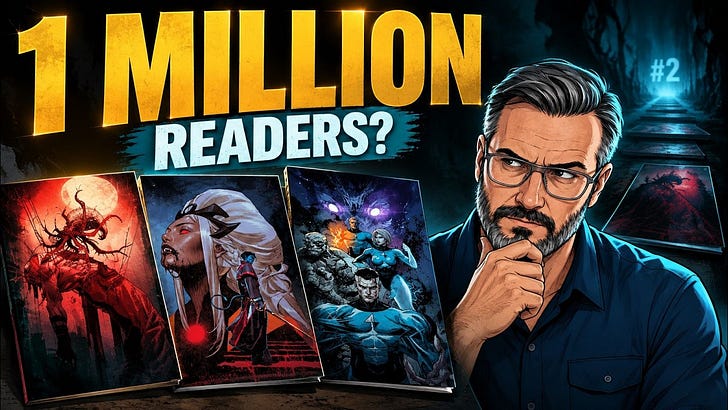
Is Marvel’s Midnight Universe Actually Building Readers?
Evaluation and Summary
Comical Opinions evaluates Marvel's newly launched Midnight Universe—a horror-themed imprint featuring Midnight Spider-Man #1, Midnight Fantastic Four #1, and Midnight X-Men #1—which generated over 1 million combined retailer orders. The host challenges the assumption that launch orders equal actual readership, framing the central question: Is Marvel building a real horror universe or just capitalizing on launch hype? The episode applies three structured tests to assess the launch's viability. The Universe Test examines whether the three books feel genuinely interconnected as a shared universe rather than standalone horror riffs on existing franchises. The Horror Engine Test evaluates whether each title establishes a sustainable horror premise capable of supporting an ongoing series beyond the debut issue. The Commitment Test directly measures whether the #1s provide sufficient reason for readers to purchase issue #2 at $4.99. The host contextualizes Marvel's strategy as aggressive, noting that Marvel cleared its regular October 7 schedule to spotlight the Midnight books—a move explicitly compared to DC's competing Absolute Universe strategy. This framing highlights the competitive landscape and suggests the launch is as much about market positioning as creative merit. A key insight distinguishes between launch metrics and actual readership: 1 million retailer orders reflect retailer expectations and distributor enthusiasm, not confirmed sales to consumers or long-term retention rates. The episode identifies this gap as the central problem Marvel must solve. The structure includes a "Million-Copy Problem" segment and a "Fair Counterpoint" section, suggesting the host attempts balanced analysis rather than pure criticism. The episode concludes by identifying what Midnight #2 must prove to validate the universe's long-term viability. The host provides linked reviews of all three titles on their Substack, offering deeper analysis for interested listeners. The episode ends with direct questions to the audience about their perceptions of the books' interconnectedness, which #1 was most compelling, and whether they're committing to the pull list or waiting for proof of staying power. Overall, this is a focused, timely critique of a major Marvel initiative that separates marketing success from creative substance.
Verdict: A timely, well-structured critique that asks the right questions about Marvel's launch strategy and applies clear analytical frameworks to separate marketing success from creative substance, though reliance on external reviews limits in-episode depth.
News rubric
-
Accuracy and sourcing 4/5 20%
Cites specific Marvel data (1 million orders), actual comic titles and prices ($4.99), and verifiable launch strategy (October 7 schedule clearance); links to full reviews for deeper sourcing, though the episode itself doesn't detail specif
-
Balance and context 4/5 20%
Acknowledges a 'Fair Counterpoint' section and avoids dismissing the launch outright; contextualizes Marvel's strategy against DC's Absolute Universe, providing competitive framing; distinguishes between retailer orders and actual readershi
-
Timeliness and relevance 5/5 15%
Episode published October 8, 2026, one day after the Midnight Universe launch on October 7; directly addresses current Marvel strategy and competitive positioning with DC; highly relevant to comic readers and industry observers tracking maj
-
Substance 4/5 15%
Provides three structured analytical frameworks (Universe, Horror Engine, Commitment tests) with clear methodology; identifies the core problem (launch orders vs. readership); includes counterargument and forward-looking analysis of what #2
-
Delivers on its title 5/5 15%
Title asks 'Is Marvel's Midnight Universe Actually Building Readers?' and the episode directly answers this through three tests designed to measure reader retention and engagement; distinguishes between launch hype and actual audience build
-
Value for time 4/5 15%
17 minutes is appropriate for the scope; structured with clear timestamps and logical flow from problem statement through three tests to conclusion; some value lost by directing listeners to external reviews rather than summarizing key find
Worth it if you follow Marvel comics, care about the Midnight Universe launch, or want a sharp take on whether Marvel's aggressive strategy will convert launch orders into sustained readership.
Based on the episode description. AI-generated; it can be wrong.