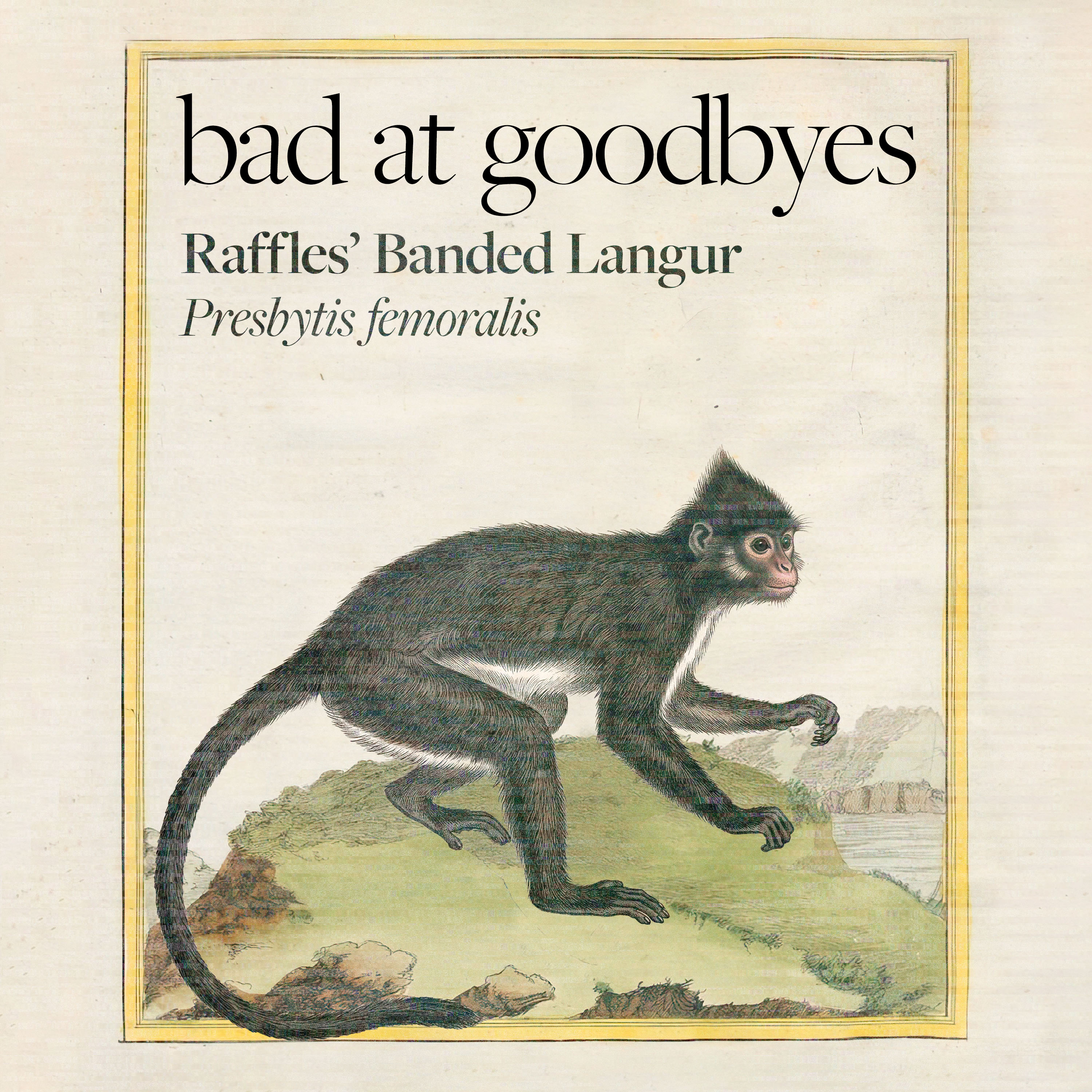
Bad at Goodbyes episode 089 focuses on Raffles' Banded Langur (Presbytis femoralis), a critically endangered primate native to Southeast Asia, particularly Singapore and southern Malaysia. The episode is structured around a 43-minute deep dive into this species, with approximately 29 minutes dedicated to species information (02:05–31:03), followed by citations, music, and a pledge segment.
Based on the extensive reference list, the episode covers multiple dimensions of the langur's biology and conservation status. The research draws from peer-reviewed sources addressing the species' distribution across Malaysia, Singapore, and Sumatra; its dietary habits in secondary forests; daily activity budgets; and reproductive phenology in the context of climate change. The show notes indicate coverage of conservation breeding programs, citizen science initiatives in Singapore, and ethnoprimatological research revealing previously unknown populations in Pahang, Malaysia.
A particularly notable recent discovery cited is the 2026 sighting of the species at Bukit Timah Nature Reserve after 39 years of absence, suggesting the episode includes current conservation developments. The research also encompasses population viability analysis, non-invasive DNA sampling methods that revealed subspecies distinctions, and wildlife crossing structures facilitating movement across fragmented urban forests.
The episode appears to blend natural history with conservation urgency, given the species' critically endangered status and its inclusion in the IUCN's list of the world's 25 most endangered primates. The show directs listeners to Mandai Nature for further conservation information, positioning itself as an educational resource with conservation intent.
The host acknowledges in a note on accuracy that they are a musician without extensive academic background, explicitly inviting fact-checking and directing scholars to primary sources. This transparency about limitations is notable. The episode structure—intro, species information, citations, music, pledge—suggests a consistent format across the Bad at Goodbyes series.
The breadth of cited research (25+ sources spanning 2016–2026) indicates substantial preparation, though the show notes alone don't reveal the depth of explanation, narrative quality, or how accessibly complex primatological and conservation concepts are presented to a general audience.
Verdict: Well-researched episode on a genuinely endangered species with recent conservation developments, supported by rigorous sourcing, though accessibility and pacing remain unverified from show notes alone.
Science rubric
Scientific accuracy4/525%
Extensive peer-reviewed sources cited (25+ references from IUCN, Scientific Reports, primatology journals); host transparently acknowledges non-academic background and invites fact-checking, suggesting careful sourcing despite potential gap
Clarity for non-expertsn/a
Show notes do not describe how concepts are explained, pacing, or use of analogies; cannot assess accessibility without hearing the actual episode.
Sense of discovery4/519%
Recent 2026 rediscovery after 39 years, ethnoprimatological findings of new populations, and non-invasive DNA subspecies revelations suggest genuinely fresh material beyond basic species facts.
Substance4/519%
29 minutes of species information supported by research spanning biology, behavior, diet, climate impacts, conservation breeding, and citizen science; substantial depth indicated by citation breadth.
Delivers on its title5/519%
Title promises Raffles' Banded Langur; episode structure and citations confirm comprehensive coverage of that species across multiple dimensions.
Value for time3/519%
43-minute runtime with 29 minutes of core content plus citations, music, and pledge segments; pacing cannot be fully assessed from notes, but structure suggests reasonable allocation though some padding likely.
Worth it if you're interested in endangered primates, Southeast Asian conservation, or want a detailed natural history of a species most people have never heard of.
Based on the episode description. AI-generated; it can be wrong.
Show notes
Raffles' Banded Langur :: Presbytis femoralis
Bad at Goodbyes :: Episode 089
On today’s show we learn about the Raffles' Banded Langur, a critically endangered mammal, a primate, native to southeast Asia, to Singapore and southern Malaysia. Its scientific name is Presbytis femoralis and it was first described in 1838.
For more information about Raffles' Banded Langur conservation please see Mandai Nature at https://www.mandainature.org/ .
(00:05) Intro
(02:05) Species Information
(31:03) Citations
(33:20) Music
(41:20) Pledge
Research for today’s show was compiled from:
Ang, A., Boonratana, R. & Nijman, V. 2022. Presbytis femoralis. The IUCN Red List of Threatened Species 2022: e.T39801A215090780. – https://dx.doi.org/10.2305/IUCN.UK.2022-1.RLTS.T39801A215090780.en
Ang, A., D’Rozario, V., Jayasri, S. L., Lees, C. M., Li, T. J., & Luz, S. (2016). Species action plan for the conservation of Raffles’ banded langur (Presbytis femoralis femoralis) in Malaysia and Singapore. IUCN SSC Conservation Breeding Specialist Group. – https://portals.iucn.org/library/node/47506
Ang, A., Jabbar, S., D’Rozario, V., & Lakshminarayanan, J. (2021). Citizen science program for critically endangered primates: A case study from Singapore. Primate Conservation, 35, 179–188. – http://www.primate-sg.org/storage/pdf/PC35_Ang_et_al_Citizen_science.pdf
Ang, A., Roesma, D. I., Nijman, V., Meier, R., Srivathsan, A., & Rizaldi (2020). Faecal DNA to the rescue: Shotgun sequencing of non-invasive samples reveals two subspecies of Southeast Asian primates to be Critically Endangered species. Scientific Reports, 10(1), 9396. https://doi.org/10.1038/s41598-020-66007-8
Cherian, A. (2023, February). Raffles' banded langur. New England Primate Conservancy. – https://neprimateconservancy.org/raffles-banded-langur/
Ding Li Yong. (2025). [Sound recording from] Xeno-Canto. XC961056. – https://www.xeno-canto.org/961056
Er, J. (n.d.). Introducing our elusive wild neighbours. [Singapore] National Parks Board. Retrieved October 3, 2026. – https://www.nparks.gov.sg/publications-resources/articles/introducing-our-elusive-wild-neighbours
Haris, H., Othman, N., Kaviarasu, M., Najmuddin, M. F., Abdullah-Fauzi, N. A. F., Ramli, F. F., Sariyati, N. H., Ilham-Norhakim, M. L., Md-Zain, B. M., & Abdul-Latiff, M. A. B. (2024). Ethnoprimatology reveals new extended distribution of critically endangered banded langur Presbytis femoralis (Martin, 1838) in Pahang, Malaysia: Insights from indigenous traditional knowledge and molecular analysis. American Journal of Primatology, 86, e23631. – https://doi.org/10.1002/ajp.23631
Haris, N. (2021). DNA metabarcoding and phytochemical analysis of plants consumed by banded langur (Presbytis femoralis) in Johor. [N. Haris'] Master's thesis, Universiti Tun Hussein Onn Malaysia. UTHM Institutional Repository. – https://eprints.uthm.edu.my/6435/
iNaturalist - Singapore
Lai, D. (2026, August 3). Critically endangered Raffles’ banded langur spotted at Bukit Timah Nature Reserve after 39 years. The Straits Times. – https://www.straitstimes.com/singapore/critically-endangered-raffles-banded-langur-spotted-at-bukit-timah-nature-reserve-after-39-years
Malaysian Palm Oil Council. (2021, September 1). Will Malaysia be able to weather the decline in palm oil exports to the United States? MPOC Market Insight. – https://www.mpoc.org.my/will-malaysia-be-able-to-weather-the-decline-in-palm-oil-exports-to-the-united-states/
Mittermeier, R. A., Reuter, K. E., Rylands, A. B., Jerusalinsky, L., Schwitzer, C., Strier, K. B., Ratsimbazafy, J., & Humle, T. (Eds.). (2022). Primates in peril: The world’s 25 most endangered primates 2022–2023. IUCN SSC Primate Specialist Group, International Primatological Society, & Re:wild. – https://static1.1.sqspcdn.com/static/f/1200343/28551465/1665759930773/Top-25-Primates-2022-2023.pdf
Najmuddin, M. F., Haris, H., Norazlimi, N., Md-Zain, B. M., Abd Rahman, M.-R., Shahrool-Anuar, R., Hassan, A. H., & Abdul-Latiff, M. A. B. (2020). Daily activity budget of banded langur (Presbytis femoralis) in Malaysia. Journal of Sustainability Science and Management, 15(5), 84–97. – https://doi.org/10.46754/jssm.2020.07.009
Numata, S., Yamaguchi, K., Shimizu, M., Sakurai, G., Morimoto, A., Alias, N., Noor Azman, N. Z., Hosaka, T., & Satake, A. (2022). Impacts of climate change on reproductive phenology in tropical rainforests of Southeast Asia. Communications Biology, 5(1), Article 311. – https://doi.org/10.1038/s42003-022-03245-8
Najmuddin, M. F., Haris, H., Norazlimi, N., Ruslin, F., Matsuda, I., Md-Zain, B. M., & Abdul-Latiff, M. A. B. (2021). Dietary habits of free-ranging banded langur (Presbytis femoralis) in a secondary-human modified forest in Johor, Malaysia. Zoological Studies, 60, Article 67. – https://doi.org/10.6620/ZS.2021.60-67
Rizaldi, Ilham, K., Prasetio, I., Lee, Z. H., Jabbar, S., & Ang, A. (2019). Preliminary study on the distribution and conservation status of the East Sumatran banded langur Presbytis femoralis percura in Riau Province, Sumatra, Indonesia. Asian Primates Journal, 8(1), 25–36. – http://static1.1.sqspcdn.com/static/f/1200343/28234574/1577091893337/2019Dec23_Article_3.pdf
Tay, L. S., Choo, R., Khoo, M. D. Y., Kong, E., Chan, Y. X., Neo, W. H. Y., Ow, S., Toh, Y. H., Ling, H., Soh, M. C. K., Lee, B. P. Y.-H., Loo, A. H. B., & Er, K. B. H. (2024). A suite of wildlife crossing structures facilitates mammal movement across tropical forest fragments in a city. Ecosphere, 15(12), Article e70114. https://doi.org/10.1002/ecs2.70114
Woolloff, A., Svensson, M. S., Jabbar, S., Ang, A., & Nijman, V. (2023). Population viability analysis of the population of Raffles’ banded langurs Presbytis femoralis in Singapore. Raffles Bulletin of Zoology, 71, 542–552. – https://doi.org/10.26107/RBZ-2023-0041
Wikipedia – https://en.wikipedia.org/wiki/Raffles%27_banded_langur
Please find us on the web at Bad at Goodbyes and on instagram . Please subscribe and rate/review Bad at Goodbyes wherever you listen to podcasts . Please help spread the word about the show and about the species we feature. Please take care of each other, and all of our fellow travelers.
A note on accuracy: I strive for it! These episodes are well-researched and built from scholarly sources, hoping to provide an informed and accurate portrait of these species. That said, I’m a musician! I am not an academic and have limited scientific background. I may get things wrong! If you are using this podcast for scholarship of any kind, please see the cited sources and double-check all information.