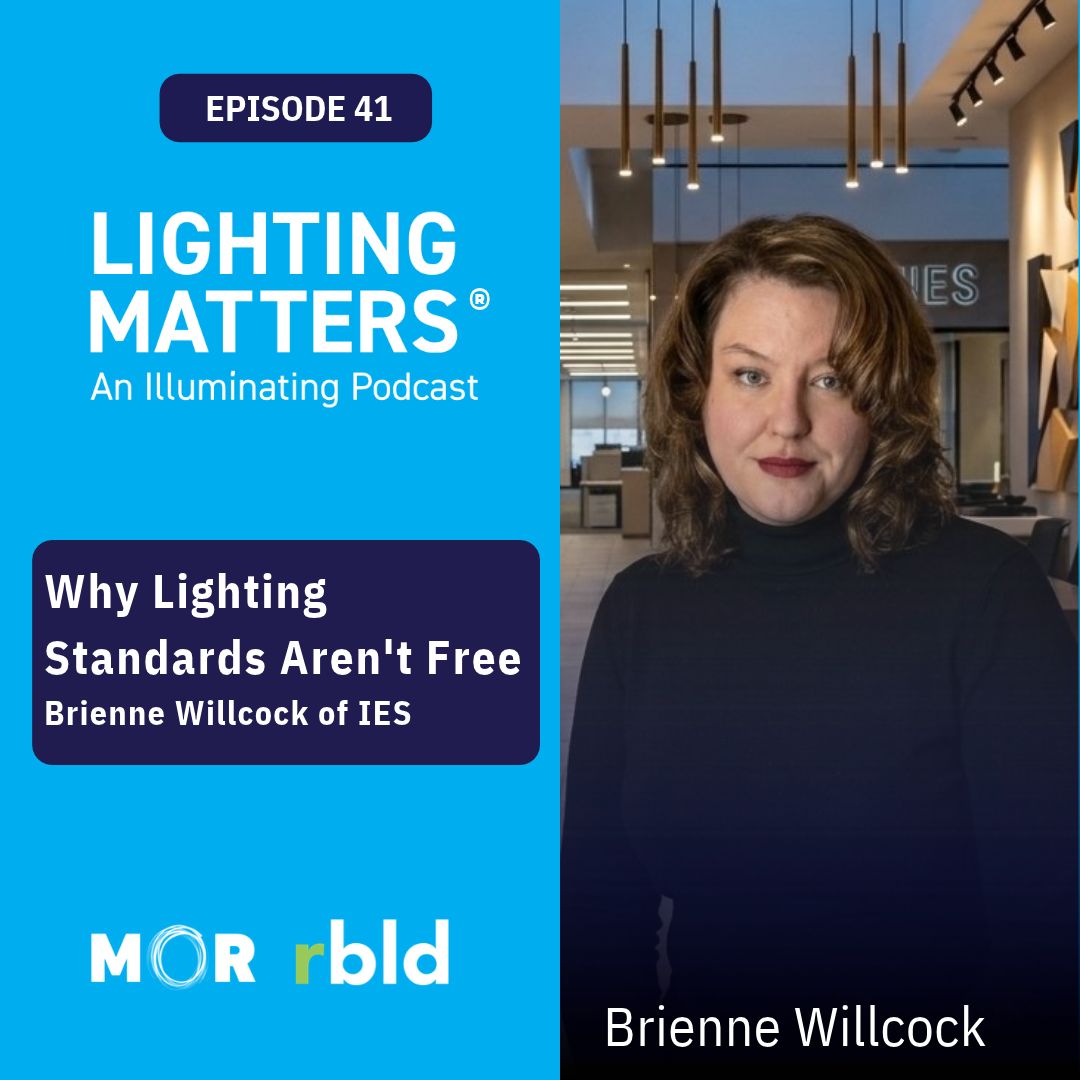
Why Lighting Standards Aren't Free - w Brienne Willcock
Evaluation and Summary
Lighting Matters hosts Lisa Reed and Avi Mor interview Brienne Willcock, Associate Executive Director at the Illuminating Engineering Society (IES), to explore why lighting standards carry costs and what value they deliver. Willcock brings deep industry credibility: she's a former architectural lighting designer, past president of the Detroit IES section, and was named to Lighting Magazine's 40 Under 40 in 2017. The episode traces Willcock's career path from fine art and flower color-matching into standards leadership, then pivots to substantive industry topics. Key segments cover IES's organizational expansion through mergers with the Audio Engineering Society (AES) and the National Council on Qualifications for the Lighting Professions (NCQLP), positioning these bodies as increasingly central to the built environment. The hosts dig into manufacturer funding fatigue and the fragmented landscape of competing lighting organizations. A major focus is IES's financial turnaround after six years operating in the red, framed as an advocacy and sustainability challenge. Willcock explains the hidden value embedded in IES files and standards development—the real costs behind creating and maintaining recommended practices that the industry relies on but often takes for granted. Rather than treating standards as abstract bureaucracy, the episode positions them as products requiring investment and expertise. A particularly distinctive segment borrows a trust-building framework from healthcare, applying the patient advocacy model to how lighting professionals earn client confidence. This cross-disciplinary angle suggests Willcock thinks beyond siloed industry thinking. The episode closes with a personal touch: Willcock's favorite illuminated space, the Detroit Institute of Arts, grounding the abstract discussion in aesthetic experience. The episode promises to explain why standards aren't free and delivers on that premise, though the show notes suggest the conversation stays somewhat insider-focused. The framing emphasizes advocacy, organizational strategy, and industry economics rather than technical deep-dives into specific standards. For practitioners and industry stakeholders, this offers rare access to IES leadership thinking about sustainability, trust, and the value proposition of standardization itself.
Verdict: A well-credentialed, insider-focused episode that delivers on its promise to explain standards economics, but limited appeal beyond the lighting industry and no evidence of breakthrough insight or storytelling.
Arts rubric
-
Insight into the work 3/5 20%
Willcock explains the economics and organizational logic behind standards development, but the show notes don't indicate technical or craft-level insight into lighting design itself.
-
Expertise and access 5/5 20%
Willcock is Associate Executive Director at IES with 15+ years of industry credibility, architectural lighting design background, and leadership roles; hosts are practicing lighting designers—genuine practitioners with authority.
-
Sparks curiosity 3/5 15%
The topic (standards economics and organizational strategy) is niche; likely to intrigue industry insiders but may not spark broader curiosity about lighting design itself.
-
Substance 3/5 15%
Show notes indicate solid topical coverage (mergers, funding, trust models, IES file value) but suggest a conversational format that may include padding; no evidence of dense information throughout.
-
Delivers on its title 5/5 15%
Title promises explanation of why lighting standards aren't free; episode directly addresses IES's costs, funding model, and the value behind standards development.
-
Value for time 3/5 15%
62 minutes for an industry-focused conversation with clear segments; reasonable pacing but length suggests some stretching for a niche topic without evidence of exceptional tightness.
Worth it if you work in lighting design, standards development, or architectural practice and want to understand IES's organizational strategy and the business case for professional standards.
Based on the episode description. AI-generated; it can be wrong.